Doctor of Philosophy (Ph.D.)
English, Rhetoric and Composition
Pennsylvania State University
2011
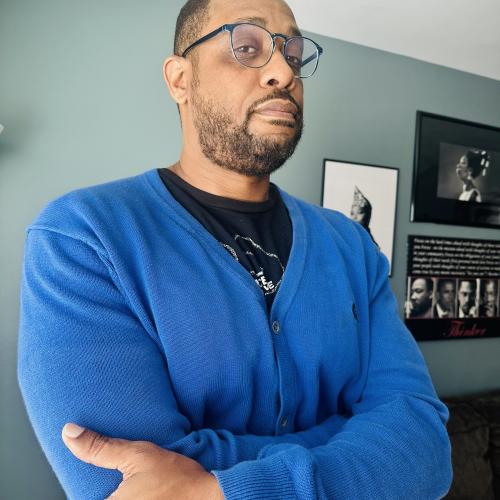
David F. Green Jr., Ph.D. is an associate professor in the Department of Literature and Writing and the associate chair of writing at Howard University. He remains committed to serving historically underrepresented students and theorizing rhetoric and composition practice at minority serving institutions.
He earned his PhD in English from Pennsylvania State University with an emphasis in African American Rhetoric and Writing. Dr. Green’s teaching and research focuses on theories of writing and linguistic justice, as well as the verbal traditions of African Americans expressed through literature, Hip Hop and Black popular culture. He has published a textbook on Black Writing Studies (BWS), Visions and Cyphers: Explorations of Literacy Discourse and Black Writing Experiences (2016), and he has published essays that appear in journals and collections such as Changing English, College Language Association Journal, College English and The Lauryn Hill Reader. He is a past secretary of the Conference on College Compositions and Communication and a past member of the Modern Language Association and Conference on College Compositions and Communication joint task force on AI Writing. He is currently the Vice President of the Council of Writing Program Administrators (CWPA) and continues to serve on special tasks forces for the study of AI and Writing within the MLA and CCCC organizations. He continues to facilitate workshops, serve as a speaker, and an advocate on issues related to writing, equity, culture, and social justice.
English, Rhetoric and Composition
Pennsylvania State University
2011
English, African American Literature
Pennsylvania State University
2007
English
Hampton University
2004
As a scholar I am deeply invested in culture, language, and the performance of self in writing. I see those areas, as well as related interests in race, teaching, and literacy as central to the types of research I do and questions I engage. More specifically, these interests allow me to explore some of the social and educational inequalities that I witnessed or experienced growing up in Newark NJ and teaching in Newark and Norfolk, VA public school systems. I was raised by two teachers and I am very sensitive to the way education provides or denies access to important social and personal needs. Pedagogy---the leading of minds whether public, alternative, or academic to a critical understanding of their surroundings---is a core element of modern communication practices and of various modes of identification or persuasion. For me, pedagogy is inherently rhetorical often influencing my intellectual journey and personal interests in ways that shape my scholarly identity. In addition to pedagogy, African American expressive culture represents another area of serious interest. In particular, legacies of bondage and asymmetrical social relations provide customs, rituals, and belief systems that guide my reading of social phenomena and the way I navigate the public sphere. It is this base that guides and most directly shapes my identity as a scholar, colleague, and citizen. This research derives from a distinctive understanding of African American Rhetoric. Rhetoric, within the popular imagination maintains a troublesome position as the use of language to deflect or deceive, but as an intellectual practice rhetoric frames the study of the way people use symbols, language, and images to shape or inform thinking on a particular topic. African American rhetoric examines the artistic and political forms of communication that African descendants within the New World developed to both form and critique community. My interests lay mainly within the way African American people use language strategically to convey complex ideas about a people and their struggle. For that reason, I examine music, oratory, politics, literature, and social practices to gain a deeper understanding of the way a people express and define themselves. Under this umbrella I take a deep interest in the artistic forms, social practices, and intellectual homages that exist within Hip Hop. I view Hip Hop as a contemporary expression of African American literature and a powerful practice for examining contemporary Black culture.
Visions and Cyphers: Explorations of Literacy, Discourse, and Black Writing Experiences
VISIONS AND CYPHERS is a rhetorical reader that takes a writing-about-writing approach to literacy and composition studies, encouraging students to think through the role of writing and writing instruction in their academic and social development. Employing essays that consider race, culture, and difference in discussions about writing instruction and composition practices, Visions and Cyphers stresses the idea that writing is a fluid and purposeful mixture of language, design, and cultural choices. The essays featured in Visions and Cyphers are authored by an impressive range of diverse scholarly writers, each of whom is prominent in the field of composition and literacy studies and each of whom engage in conversations about language, writing, culture, and rhetorical possibilities from intense and creative perspectives.
In the MLA-CCCC Joint Task Force on Writing and AI Working Paper: Overview of the Issues, Statement of Principles, and Recommendations, our task force provided guidance on generative AI (GAI) tools, particularly large language models (LLMs), which are rapidly proliferating, changing, and increasingly being used in a variety of settings.
This working paper discusses the risks and benefits of generative AI for teachers and students in writing, literature, and language programs and makes principle-driven recommendations for how educators, administrators, and policy makers can work together to develop ethical, mission-driven policies and support broad development of critical AI literacy.
Race, Hip-Hop, and Academe: David Green, Khirsten L. Scott, and Dennis L. Winston in Conversation
This roundtable discussion evolved out of a few discussions about hip-hop as a form of African American discourse, and an ongoing reconsideration of each professor’s personal experiences with race and racism that animates their thinking about antiracist work and their work as educators. The three participants in this dialogue each highlight perspectives on working in academe as Black professors, as well as differing approaches to interpreting and enacting critical dispositions toward the current struggles for social change. Part of this collective’s interest in hip-hop as a rich area of dialogue stems from the view that equitable university communities can be fostered and reimagined through shifting the boundaries within academe that often separate personal experience from intellectual work.
Views from the Bricks: Notes on Reading and Protest
In reflecting on the African American protest tradition and the outsized role of storytelling as one of its most profound tools for reasoning through social unrest and social injustice, I believe our ability to understand Hip Hop music’s complicated messaging will be essential to examining critical responses to legal and social victimization. For me, Hip Hop remains vital to discussions of the African American protest tradition and to the critical work of reflection, healing, and organizing. The recent rise of Hip Hop songs, such as Kendrick Lamar’s “We Gon Be Alright,” as popular protest songs are testament to Hip Hop music’s function with the lives of marginalized people (Limbong). Moreover, Hip Hop artists’ skillful manipulation of multimedia resources across several digital and print platforms represents a bridge between tradition and social change.