
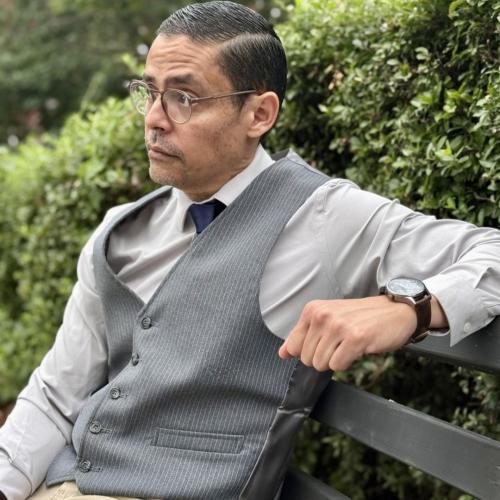
Roberto Perez
Lecturer
Department/Office
- World Languages & Cultures
Biography
Roberto Carlos Pérez (Granada, Nicaragua). Musician, writer, and essayist. Studied Music at the Duke Ellington School of the Arts. Earned a Bachelor of Arts in Classical Music from Howard University in Washington, D.C, as well as a Master in Spanish Medieval and Golden Age Literature from the University of Maryland. Has authored: (2012) the collection of short stories Alrededor de la medianoche y otros relatos de vértigo en la historia (Around Midnight and Other Tales of Vertigo in History, three editions, 2012, 2012, 2016); the novels Un mundo maravilloso (A Wonderful World, two editions, 2027, 2026), and Rodrigo: un relato sobre el Cid (Rodrigo: A Cid Story), published in 2020. Roberto Carlos Pérez has also published the following books of essays: Rubén Darío: una modernidad confrontada (Rubén Darío: A Confronted Modernity, first edition in 2018; second edition in 2021); Temas españoles: del siglo XII al XVII (Spanish Themes: From the XII to the XVII Century, 2022); El mundo que veo (The World as I See It, 2025). Has also edited the following books: a tribute to Mexican poet José Emilio Pacheco (Queen Sofía Award for Ibero-American Poetry, 2009, and Cervantes Award, 2009): José Emilio Pacheco en Maryland, 1985-2007 (José Emilio Pacheco in Maryland, 1985-2007); an annotated edition of the 1910 novel El vampiro (The Vampire) by Honduran modernist Froylán Turcios; of the novel Trópico, (1971), (Tropic), by Honduran writer Marcos Carías Reyes, who belonged to the so-called “Dictatorship Generation”; the 1947 poetry collection Breve Suma by avant-guard Nicaraguan poet Joaquín Pasos; Después que muera (2025), an anthology of the famed Honduran Modernist Poet Juan Ramón Molina; La voz dentro de la voz (2025), an anthology of the deceased revolutionary young poet Amada Libertad. His short stories have been included in the following anthologies: Flores de la trinchera (muestra de la nueva narrativa nicaragüense), (Flowers In the Trenches: A Sample of New Nicaraguan Narrative, 2012); Un Espejo roto, 2014 (A broken mirror); the German anthology Zwischen Süd und Nord: Neue Erzähler aus Mittelamerika (2014); Nicaragua cuenta, 2018 (Nicaraguan stories); 100 cuentos de Asia, Europa & América, 2021 (100 Short Stories From Asia, Europe and the Americas); Desde el centro de un continente. Antología minimalista del cuento centroamericano, 2026 (From the Heart of a Continent: Minimalist Anthology of the Central American Short Story). Has authored over one hundred and thirty works of literary criticism, among them essays, articles, and reviews, the vast majority in peer-reviewed journals, and prologued the poetry books Imprecisa imagen de los noventas (Young Nicaraguan Poetry, 2019), El domador de caballos (Alberto López Serrano, 2025) and El pequeño cuerpo de la esperanza (Jesús Martínez Jurado, 2026). His column Prosa de prisa: diario de un nicaragüense en el extranjero (Rushed Prose: Diary of a Nicaraguan in Exile) is published in various countries, as well as his critical and creative works, including the United States, Spain, Mexico, Chile, Perú, Rumania, Germany, El Salvador, Honduras, and Costa Rica. Roberto Carlos Pérez is a Full Member of the Nicaraguan Academy of the Language (ANL), and Corresponding Member of the Spanish Royal Academy (RAE), of the North American Academy of the Spanish Language (ANLE), and Honorary Member of the Atheneum (El Salvador). He is co-founder and Chief Editor of the journal Ágrafos, member of the Editorial Board of Revista Abril, member of the editorial team of the journals published by the North American Academy of the Spanish Language, blind reader of the Ajkö Ki Journal, and Founder and Chief Editor of Anonimato Ediciones. In 2026, Roberto Carlos Pérez was granted an honorary doctorate in literature (letters) by Fundación Cultural Alkimia in El Salvador. His areas of research include Spanish Literatures (Middles Ages and Golden Age), the evolution of the Spanish language from the Middle Ages to postmodernity, Hispanic America and its literatures, the Modernist Movement, and the effects of the civil conflicts in Central America in the literary productions stemming from them as well as its social and cultural implications.