
Master of Science (M.S.)
Data Analytics and Computational Social Science
University of Massachusetts - Amherst
2027
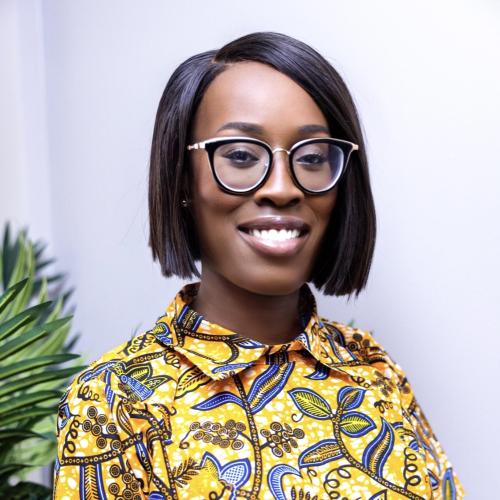
Amy Yeboah Quarkume, Ph.D., affectionately known as Dr. A, is a daughter of Africa, scholar, filmmaker, data scientist, and Associate Professor in the Department of Earth, Environment and Equity at Howard University. Her interdisciplinary scholarship sits at the intersection of data science, artificial intelligence, environmental justice, maternal health, and Africana Studies. She holds a Ph.D. in African American Studies, two master’s degrees in Sociology and African American Studies, and certificates in Data Analytics from Harvard Extension School and the University of Massachusetts. Quarkume is an Andrew W. Mellon New Directions Fellow, a National Center for Atmospheric Research Innovator Fellow, and a White House Initiative on HBCUs All-Star Campus Mentor.
Quarkume serves as Director of the Master of Science in Applied Data Science and Analytics program at Howard University, where she is helping advance the University’s efforts to become a hub for socially conscious data science research, education, and the training of the next generation of data scientists. Her work centers on artificial intelligence, algorithmic bias, data inequality, environmental justice, and the ways technology can both reproduce and address inequities.
She also serves as Research Director for Howard University’s Center for Women, Gender and Global Leadership, where her research agenda examines the intersections of women, families, health, environment, technology, and data. This work extends her longstanding scholarship on Black women into emerging research on maternal health disparities, environmental exposures, and the development of community-centered technological solutions.
Employing an Africana Studies framework, Quarkume examines the intersections of race, gender, environment, health, data, and technology. As Executive Director and Principal Investigator of the CORE Futures Lab, she leads interdisciplinary teams of graduate, undergraduate, high school, and middle school students engaged in multi-year research initiatives, including Climate Signal, Black Birthways, HBCU STARS, and Worlds of Hello.
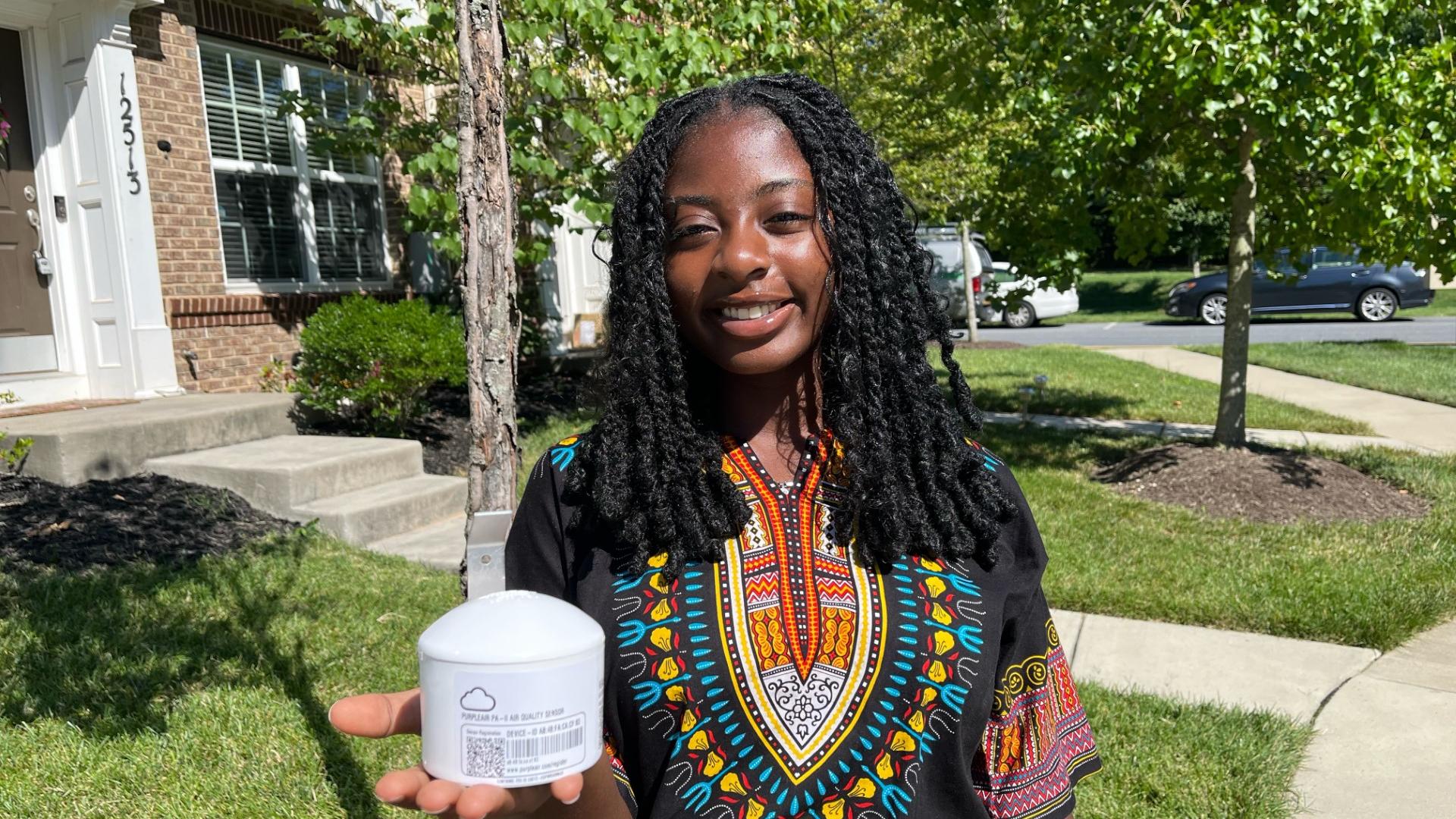
Her environmental justice research uses community-based environmental monitoring, geospatial analysis, low-cost sensors, and participatory research methods to investigate disparities in air pollution, extreme heat, flooding, and other environmental exposures. Working alongside communities, students, government agencies, and community-based organizations, her research seeks to address gaps between official environmental datasets and the conditions residents experience in their neighborhoods.
Central to this scholarship is Quarkume’s concept of “data pollution,” which examines how gaps, biases, inaccuracies, and inequities in data collection and technological systems can disproportionately affect Black, Brown, Indigenous, and historically underserved communities. Her work addresses inadequate environmental monitoring infrastructure, inequitable access to environmental information, delays in deploying data-collection technologies, and the need for meaningful community participation in environmental research and decision-making.
Through Black Birthways, Quarkume is extending this environmental justice framework into maternal health. Her research examines how environmental exposures—including extreme heat, air pollution, industrial land use, and neighborhood conditions—intersect with maternal health and healthcare access. This work combines environmental monitoring, community-engaged research, geospatial data, and emerging technologies to better understand and address disparities affecting mothers and families.
Quarkume’s research also investigates the potential of artificial intelligence to support climate adaptation and health equity. Her work explores community-centered applications of AI for environmental monitoring, extreme-weather preparedness, maternal health, and access to health and community resources, while critically examining algorithmic bias, unequal data representation, and the unintended consequences of AI. She emphasizes that emerging technologies must be developed with, rather than simply deployed within, the communities they are intended to serve.
In the fields of education and technology, Quarkume draws upon more than a decade of experience with the Children’s Defense Fund Freedom Schools program and the Philadelphia Freedom Schools program, where she worked in administration and curriculum development. She has translated this experience into educational programs, human-resource training, and study-abroad engagement opportunities grounded in diversity, inclusion, and culturally responsive pedagogy.
Quarkume is also the developer of the HELLO BLACK WORLD curriculum, designed for Africana Studies majors, minors, and students across the humanities and social sciences who want to develop data and computer science competencies while exploring African and African diasporic contributions, innovation, and imagination. She has also served as an NSF-funded I-Corps Principal Investigator, developing an innovative language-learning solution for children ages four and older that incorporates natural language processing (NLP), speech-recognition technologies, and artificial intelligence.
Her scholarship in Women’s Studies has focused on Black women in higher education and increasingly examines the intersections of Black women’s experiences, environmental justice, technology, and health. Her first book, Her Truth and Service: Lucy Diggs Slowe in Her Own Words, is available from Columbia University Press.
Quarkume has published in the Journal of Women, Gender, and Families of Color, Mosaic Magazine, BAM, The Black Scholar, and CLA Journal. She is currently developing her second book project, Data Pollution and Savage Algorithms. Her scholarship and expertise have also been featured across national and international media, including BET News, PBS NewsHour, American RadioWorks, Al Jazeera America’s The Stream, Roland Martin/TV One, Philadelphia community media, and Mother Jones.
Data Analytics and Computational Social Science
University of Massachusetts - Amherst
2027
Data Analytics
Harvard University Extension School
2023
African American Studies
Temple University
2013
African American Studies
Temple University
2011
Sociology
Temple University
2010
Specialty Area: Human-centered AI
Specialty Area: Climate justice
Specialty Areas: Community-Engaged Research, Digital Equity, Health Equity, Technology and Society
This course is designed to help students think explicitly about their social responsibility as data scientists and the impact on the world of what they are building and analyzing. Using contemporary case studies from recent news stories and legal cases, students will learn about issues such as intellectual copyright, consent, data security, differences between privacy and confidentiality, difficulties of anonymization, and bias in artificial intelligence. In addition, students will be engaged with fundamental questions of justice in relation to data and computing in American society.
The HELLO BLACK WORLD curriculum has been designed for students of African descent who want to explore and develop data and computer science competencies centered around the presence of African contributions and the imagination. The curriculum addresses computer science, data science, the visualization of diverse data types, digital humanities, ethics, and communications within the Black world with a social justice lens. No previous programming or statistical background is assumed. The Intro to the Black Digital World course introduces students to the African Origins of Mathematics and Computer Science, basic python, data science and visualization of diverse data types within the Black world (e.g. text, numbers, images).
Data collection, visualization, and analysis have been entangled in the struggle for racial and social justice because they can make injustice visible, imaginable, and thus actionable. Data has also been used to oppress minority communities and institutionalize, rationalize, and naturalize systems of racial violence. With a focus on environmental justice, along with critical social science literature, students gain introductory experience and do collaborative and creative projects using real-world data.
This course studies the historical and contemporary experiences of Africana Women through the major concepts and methods of the stand-alone academic field, discipline, and meta-discipline of Africana Studies. While the course primarily focuses on Black women in America, the readings include diverse experiences, perspectives, and scholarships of women from the African continent, the Caribbean, and North and South American communities. Building off of historically African centered experiences, the readings will provide a social-historical framework for the course and will draw from many disciplines including literature, psychology, sociology, science, as well as art. A focus will be placed upon contemporary issues such as the Politics of Health and Motherhood; Art and Culture; Media and Representation; Education and STEM; Wage and Equity; Politics and Power and Crime and Punishment. In examining the experience of Black Women in America students will also capture and reflect upon the story of Black womanhood over the years and critically engage in museums, artifacts, and archives that connect to historical narratives of Black women in America.
This course provides students with an introduction to Black Education in America with a focus on contemporary issues. Organized around questions about teaching, learning, and schooling people of African descent, a critical eye is placed current social structural arguments in education policy for people of African descent. In examining the cultural and structural foundations of education, students will also reflect upon and critique their own educational experiences and articulate their own beliefs and values about teaching, learning, and schooling, and critically engage in museums, artifacts and archives that connect to historical narratives of education in America.
Co-Principal: "Targeted Infusion Project: Providing a Data Science and Analytics approach to the Honors Curriculum at Howard University," Sponsored by National Science Foundation, Federal, $399,399.00. (July 1, 2023 - August 30, 2026).
Principal: "UChicago and Data.org Capacity Accelerator Network Partner," Sponsored by Data.org, Private, $115,000.00. (June 1, 2022 - December 31, 2023).
Principal: "NSF I-Corps," Sponsored by National Science Foundation, Federal, $50,000.00.
Principal: "Early Career Faculty Innovator," Sponsored by NCAR, Private, $400,000.00. (September 2021 - September 2023).
Principal: "Mellon New Direction," Sponsored by Andrew Mellon, Howard University, $296,000.00. (April 1, 2021 - August 31, 2023).
Principal: "Bezos Earth Fund - Environmental Justice Data Collaborative Grant Program," Sponsored by Georgetown-Howard University, Private, $180,000.00. (June 1, 2022 - May 31, 2023).
Yeboah Quarkume, A. (Supporting), "Friends of Pierce Mills," Sponsored by DC Humanities, State, $60,000.00. (February 2021 - March 2022).
Principal: "Vision Grant," Sponsored by DC Humanities, Private, $60,000.00. (March 1, 2021 - February 28, 2022).
Co-Principal: "Just Futures Initiative," Sponsored by Andrew Mellon Foundation, Federal, $5,000,000.00. (2021 - Present).
The Early Career Faculty Innovator Program is a new funding opportunity for early career faculty in the social sciences and STEM outside of NCAR’s core expertise to co-develop interdisciplinary research projects in partnership with scientists and engineers at the National Center for Atmospheric Research (NCAR) in Boulder, Colorado.
The goal of this project is to incorporate data science and analytics (DSA) into the honors curriculum and co-curricular experiences in the College of Arts and Science at Howard University, targeting the disciplines of Chemistry, Biology, Mathematics, Psychology, Political Science and Economics. This project’s DSA content development activities will be guided by the incorporation of Competency-Based Education and Problem-Based Learning, both regarded as high impact practices that attract and retain high-achieving students
As a Harvard University Associate in the Institute for Quantitative Social Science (IQSS) at Harvard I will collaborate with Professor Latanya Sweeney developing curriculum for the Data Science for Social Justice program
New Directions Fellowships assist faculty members in the humanities and humanistic social sciences who seek to acquire systematic training outside their own areas of special interest.
Capacity Accelerator Network (CAN) Democratizing data skills and investing in social impact organizations’ capacity to be data-driven will lead to transformative change. The Capacity Accelerator Network will work to increase skills and support organizations, enabling them to unlock the power of data to meet their missions.
Bezos Earth Fund Announced $443 Million in Grants to Advance Environmental Justice, Conserve and Restore Nature, and Improve Monitoring and Accountability.
Humanities Vision Grant provides financial and capacity building resources to community organizations interested in creating innovative interpretations of humanities scholarship for public audiences. The grants are driven by the proposed final product; each grant will produce an educational resource that will be added to a publicly accessible, online archive.
Read: Business Insider | The problem with only talking about 'unconscious' bias
Read: NBC4 Washington | Books to Read for Juneteenth, as Recommended by DC's Black Educators
Read: Chicago Sun Times | Will George Floyd’s death with a knee on his neck become nation’s ‘Emmett Till moment?’
Read: The Wall Street Journal | Juneteenth Protests, Celebrations Planned in Major Cities
Watch: WJLA | Push for Preservation: Home of 1920's African-American educators could become DC landmark
Read: VICE | Nipsey Hussle’s Memorial Was a Celebration of African Spirituality
Read: PBS | What Beyoncé teaches us about the African diaspora in ‘Lemonade’
Her Truth and Service: Lucy Diggs Slowe in Her Own Words
Lucy Diggs Slowe (1885–1937) was one of the most remarkable and accomplished figures in the history of Black women’s higher education. She was a builder of institutions, organizing the first historically Black sorority, Alpha Kappa Alpha, while a student at Howard University in 1908; establishing the first junior high school for Black students in Washington, D.C.; and founding as well as leading other major national and community organizations. In 1922 Slowe was appointed the first Dean of Women at Howard, making her the first Black woman to serve as dean at any American university. Beyond her trailblazing career in higher education, she was a committed teacher, an ardent antiracist advocate, and even a national tennis champion.
Her Truth and Service showcases Slowe’s speeches, articles, and letters, illuminating her multifaceted accomplishments and unwavering dedication to the quest for equality and justice. In these texts, readers encounter Slowe’s powerful voice and keen intellect, witnessing her triumphs and travails as an educator, a leader, and a Black woman in a deeply exclusionary society. Slowe’s writings depict her personal and professional efforts to topple race and gender barriers and open up greater opportunities for Black women and girls, as well as the obstacles she faced in male-dominated institutions including the Howard administration. Her Truth and Service is an important document of a significant figure in the development of Black institutions and an inspiring testament to the lifelong struggle for social justice.
Making Data Science Democratic
There is the democracy we think we live in, and then there is the democracy we are actually living in. In the democracy we think we live in, individuals and communities have the power to shape their own futures, to define their own interests and act on them. In this scenario, the government is a supporter and protector of the public interest, providing infrastructure, education, public safety, clean water, and other basic needs. Data — how it is collected, managed, and deployed in public services — plays an increasingly important role in the public interest.
ChatGPT: A Digital Djembe or a Virtual Trojan Horse?
We should critically engage and evaluate the expansion of artificial intelligence models and other content-generating technologies. Here’s why.
During the 1960s Howard University held great promise, finding itself at a transformative crossroads as it related to the institutional study of Black life. On September 3, 1966 in a Washington Post article, Howard University President Nabrit declared “he would like to see enrollment eventually distributed between whites and Negroes on a 50–50 basis, and perhaps even 60–40.
Why the West Couldn’t Hear Beale Street: Baldwin’s World-sense of Female Sexuality
While scholars have noted James Baldwin’s revisionary and transformative literary approach to social constructions of race, class, gender, and crime, there has been very little conversation in that vein regarding If Beale Street Could Talk (1974). Upon its publication, many critics issued negative reviews of the novel, failing to recognize how Baldwin’s view of female sexuality both embraced notions of the body and constructs from an African-centered world-sense. Using a range of theoretical resources from Africana Studies, this paper analyzes how moving beyond Western frameworks regarding knowledge, sexual discourse, and behavior offers a new interpretation of Baldwin’s aims that reclaims and re-imagines Black sexual politics.
Reconceptualizing Black Students Going Abroad: Heritage Experiences in Theory and Practice
International Journal of Multidisciplinary Perspectives in Higher Education, v4 n1 p1-21 2019
The lack of participation in study abroad programs by Black students is a topic of persistent concern yet increasing opportunities has not yielded significant results. A closer look at study abroad programs identifies a gap in program offerings and experiences that Black students might actually desire. Reconceptualizing what Black people value from travel experiences and addressing students' primary obstacles going abroad--the financial burden, fear of anticipated racism, and finding programs of interest (Gasman, 2013)--led Howard University to offer a heritage program approach. This article looks at how the Young AfricanA Leadership Initiative (YAALI) fellowship closes the cultural gap that exists for Black students in traditional study abroad programs.

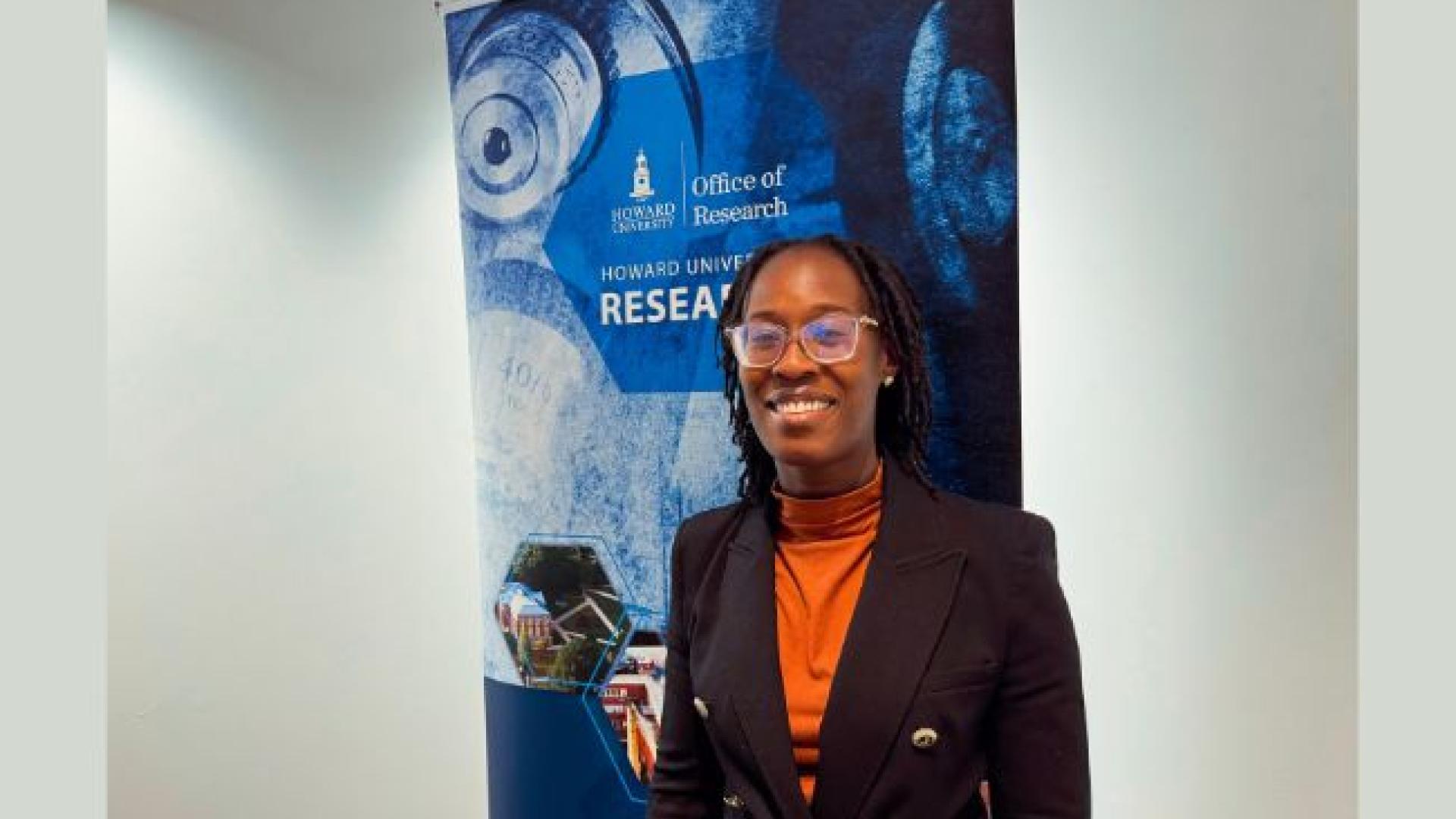

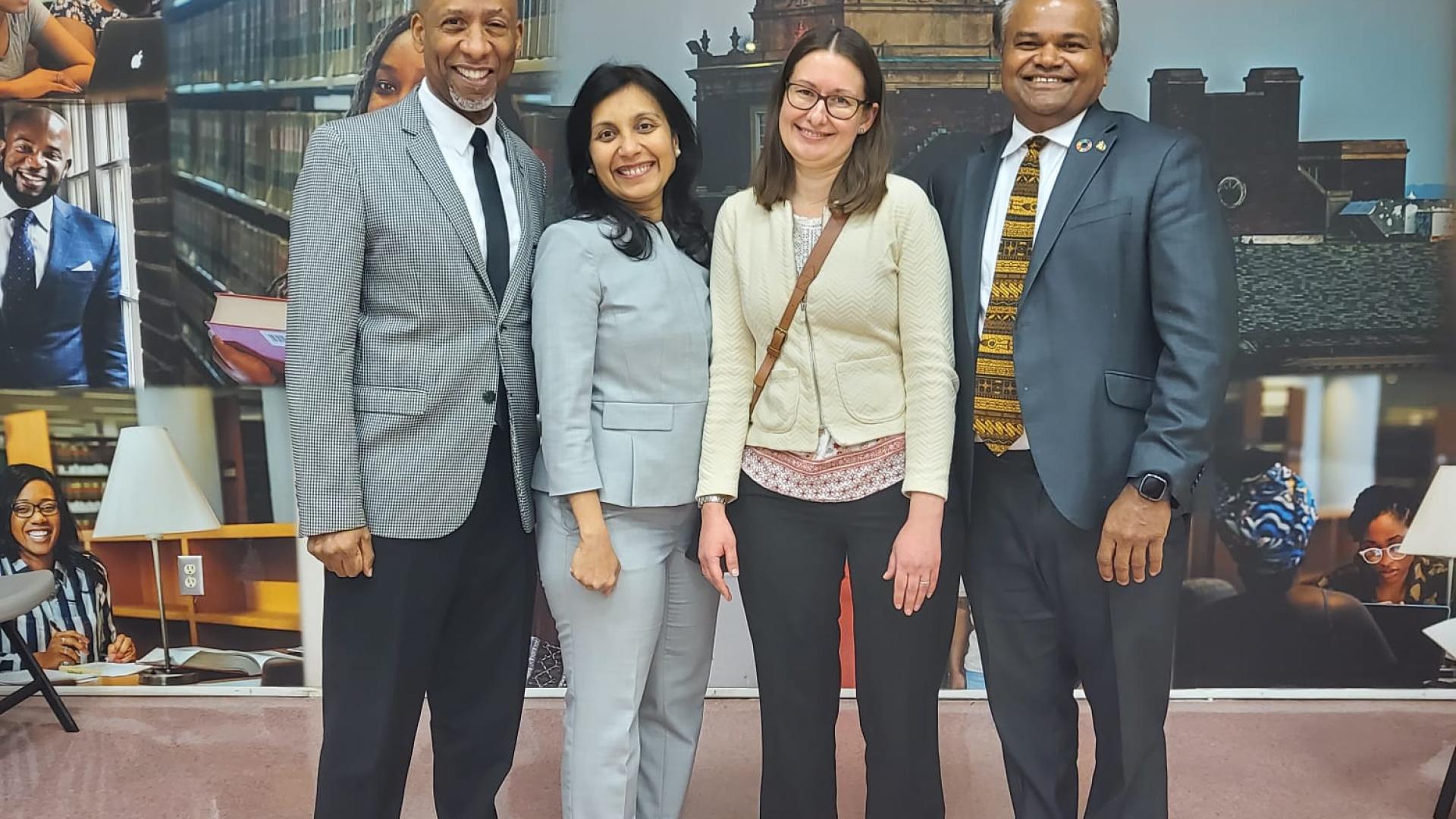


Richard's guest today is Dr. Amy Yeboah Quarkume. Amy is associate professor of Africana studies in the Department of Afro-American Studies and the director of student engagement at the Center for Women, Gender, and Global Leadership at Howard University. She is an editor of the Black Lives in the Diaspora: Past / Present / Future series and the author of the new book Her Truth and Service: Lucy Diggs Slowe in Her Own Words.
Spark Talk: Training the Impact Data Scientists of Tomorrow w/ Amy Yeboah Quarkume, David Uminsky
Have you noticed that there always seems to be a disconnect between African Americans and other people in the Diaspora? Why does it feel like being labeled "African American" is a bad thing? Sufficiently Black explores these questions with "daughter of Africa," Howard University Professor Dr. Amy Yeboah Quarkume. Dr. A explains the importance of language to limit the divide, whether people in the Diaspora are capable of cultural appropriation and the issues with Marvel's Black Panther.