
Doctor of Philosophy (Ph.D.)
Educational Measurement and Statistics
The University of Iowa
2007
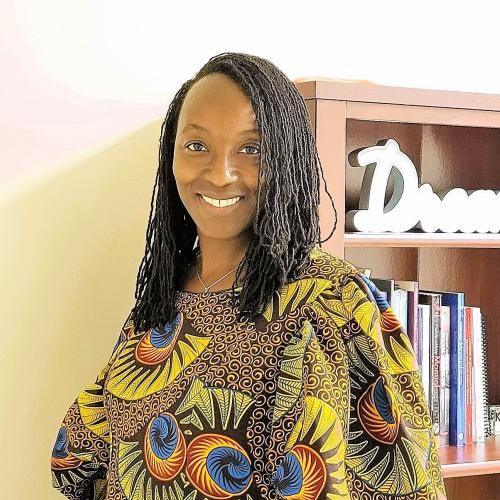
Kyndra V. Middleton, Ph.D. is a professor of Educational Psychology and Chair of the Department of Human Development and Psychoeducational Studies at Howard University where she teaches statistics and measurement courses, serves as the primary methodologist for the school, and sits on numerous university-wide committees. Her research focuses on ensuring validity, equity, and fairness for all students as well as increasing the number of underrepresented minorities in STEM fields.
Educational Measurement and Statistics
The University of Iowa
2007
Educational Measurement and Statistics
The University of Iowa
2004
Mathematical Sciences
Florida A&M University
2002
External Consultant: "Statistical and Psychometric Methods for Measuring the Extent to which Culturally Responsive Assessments Reduce Cultural Bias," National Science Foundation; 2023-2025
External Advisory Board member: "Professional Pathways of the Multiply Marginalized in Physics," National Science Foundation; 2020
Principal Investigator: "Development and Validation of an Academic Acculturation Scale," Howard University Walter and Theodora Daniel Endowed Educational Research Find; 2019-2020
Implications of Culturally Responsive Assessment for Classroom Assessment Practices
This chapter examines the culturally responsive teaching-learning-assessment cycle, with a specific focus on implementing classroom assessment methods that are sensitive and responsive to the diverse cultural backgrounds of students. Firstly, the chapter explains the distinctions and progressions between culturally relevant and culturally responsive pedagogies.
From Mandated to Test-Optional College Admissions Testing: Where Do We Go from Here?
Without standardized methods for admission decisions, will all students have a fair chance at being admitted to all institutions? The authors pose a series of questions for consideration as college and university officials grapple with where to go from here regarding the use of standardized test scores for college admissions.
Out-of-school suspensions have long been shown to be detrimental to students’ academic trajectory, and Black students are disproportionally suspended more than other students. The current study used data from an urban district that has consciously worked to decrease the number of suspensions to determine if differences in suspension rates still exist between races. The study also examined teacher and school characteristics that impact suspension rates as well as examined whether suspension rates, along with other factors, predicted standardized test performance across school levels.
This study examined whether varying dimensions of teacher-child relationship quality and gender moderated associations between knowledge of negative emotion-eliciting situations and peer victimization among Black preschoolers (60 boys, 54 girls) who ranged in age from 35 to 65 months.
We examined whether early childhood preservice teachers’ emotional competence and commitment to social emotional learning moderated associations between their beliefs about social justice and self-reported tolerance for and conceptions of the negative costs of Black preschool boys’ challenging classroom behavior.