Postdoctoral Fellow
Georgia Institute of Technology
2008

Gbadebo Moses Owolabi, Ph.D. is a full professor and the director of Graduate Studies in the Department of Mechanical Engineering. He obtained his Bachelor of Science (First Class Honors) degree from the Obafemi Awolowo University, Nigeria and his doctorate from the University of Manitoba, Canada. Prior to joining Howard University, he was a Visiting Research Scholar at Georgia Institute of Technology sponsored by the Government of Canada through the Prestigious Natural Science and Engineering Research Council of Canada Postdoctoral Fellowship.
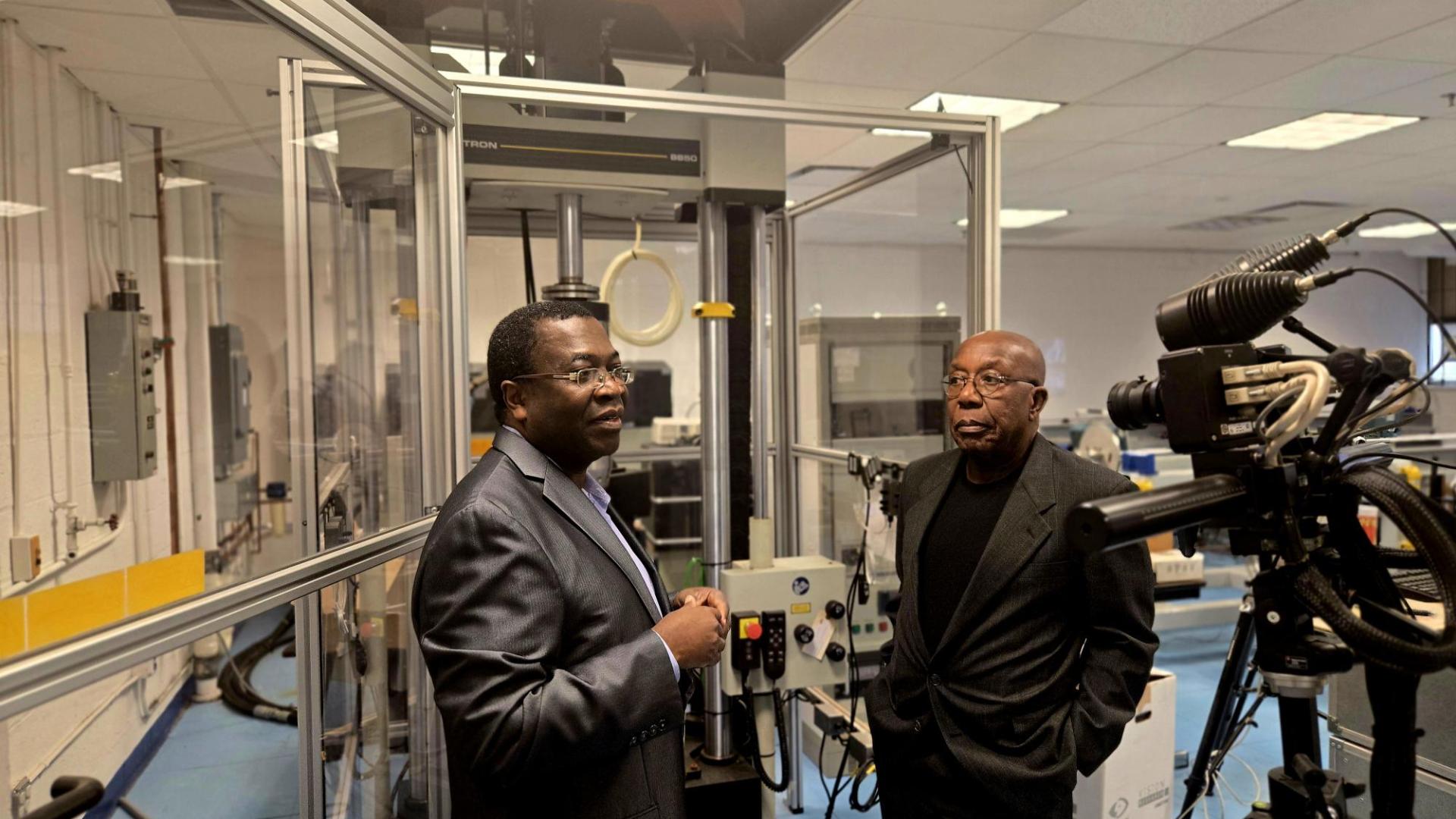
Owolabi is the founding director of the Applied Mechanics and Materials Research Lab (AMMRL) at Howard University. AMMRL supports research activities in the areas of materials processing, testing, and characterization for advanced materials at various strain rates and temperatures. AMMRL is equipped with state-of-the-art instruments including split Hopkinson pressure bars, biaxial thermomechanical test systems and ultra high-speed digital cameras with frame rate of 7 million frames per second.
Owolabi is a well-established researcher in the fields of mechanics of materials and materials science and engineering. He has performed numerous studies on the deformation, fatigue, and fracture of materials used in a variety of applications. His expertise in the field of materials science adds a unique multidisciplinary flavor to his research. The principal goal of his current research is to investigate process-microstructure-property relationships in nanostructured, ultrafine grained, and additively manufactured metallic alloys. He is also studying the effects of heat treatment and grain refinements on the deformation mechanisms and mechanical performances of multi-principal elements alloys produced via additive manufacturing (AM). The growing number of applications of AM alloys highlights the importance of understanding mechanical performances of these materials under various loading conditions and extreme environments, an area where very limited research studies have been conducted. The combination of his expertise and AMMRL resources provides a unique opportunity for advancing the knowledge of the mechanical behavior of advanced materials with several applications in the aerospace, automotive, and defense sectors
Owolabi has secured over $20 million research grant awards as principal investigator and co principal investigator from the Department of War, the Air Force Office of Scientific Research, the Army Research Office, National Science Foundation, and the Department of Energy to support his research activities in the area of additive manufacturing, fatigue and fracture mechanics at various scales, high strain rate testing and material characterization, structural integrity and health monitoring. In the area of structural integrity, Owolabi and his team have developed novel simulation-based strategies for predicting the formation and growth of small cracks in advanced materials and structures for numerous applications in large-scale industries including aerospace, ship/marine structures, pressure vessels, and other applications where fatigue is a critical issue in reliability analysis. Owolabi’s research findings have been published in over 100 articles in leading international journals and conferences proceedings and four book chapters. He has also supervised several postdoctoral fellows and masters/doctorate students as well as undergraduate researchers.
Owolabi is a Fellow of the American Society of Mechanical Engineers (ASME). As stated on ASME website “The ASME Committee of Past Presidents confers the Fellow grade of membership on worthy candidates to recognize their outstanding engineering achievements.” Owolabi was a member of the National Academies of Science, Engineering, and Medicines committee formed in summer 2020, following congressional direction to NASA, to perform an independent review of NASA’s University Leadership Initiative (ULI) and recommend options for strengthening the initiative.
Georgia Institute of Technology
2008
Mechanical Engineering
University of Manitoba
2005
Mechanical Engineering
Memorial University
2001
Mechanical Engineering (First Class)
Obafemi Awolowo University
1997
Specialty Areas: Additive Manufacturing, Fatigue and Fracture Mechanics, Multiscale Modeling and Simulations, Constitutive Modeling and Finite element Applications, High Strain Rate Testing and Materials Characterization, and Structural Health Monitoring
Consortium for Research and Education for Advanced Manufacturing of Alloys for Extreme Conditions (REAM). Department of Energy’s National Nuclear Security Administration (DOE-NNSA). $4,700,000 (in collaboration with TSU and Texas A & M). 2026-2031.
Enhanced Microstructures and Mechanical Performances of Additively Manufactured Metallic Alloys (GRT000573). Department of Defense (DOD). $794,000. 2023-2027.
Acquisition of Ultra-High-Speed Deformation and Strain Measurement System. Department of Defense (DOD). $600,750. 2024-2025.
Leading Advanced Turbine Research for Hybrid Electric Propulsion Systems NASA (ULI). $8,000,000 (in collaboration with Penn State and GT). 2021-2027.
Additive Manufacturing Post-Processing Partnership. Department of Energy (DOE)/NNSA. $3,000,000 (in collaboration with UDC, MSU and Lincoln University). 2019-2023.
Novel Methods for Fatigue Life Prediction for Turbine Engine Components. Air Force Research Lab. $400,000. 2017-2022.
Extending Advanced Manufacturing Post-Processing Activities through Acquisition of an Additive Manufacturing System Suite. Department of Defense (DOD). $596,000. 2021-2023.
Optimizing the Dynamic Response of Ultrafine Grain and Hybrid Alloys under Impact Loading. Department of Defense (DOD). $596,225. 2015-2019.
Vibration-Based Cleaning for Ash Removal from Diesel Particulate Filters. NSF-Filter Sensing Technology. $70,000. 2015-2016.
Dynamic Failure of Aluminum-Based and Polymer Matrix Composites at High Strain Rates. DOD - Army Research Office. $514,515. 2012-2016.
Microstructure-Sensitive Fatigue Design for Notched Components. Air Force Office of Scientific Research (AFOSR). $479,517. 2011-2014.
Acquisition of a Biaxial Tension-Torsion Testing System to Advance Research, Education, and Training at Howard University. AFOSR- Defense University Research Instrumentation Program (DURIP). $525,000. 2012-2014.
Acquisition of a Biaxial System to advance research, education, and training at Howard University. National Science Foundation. $367,000. 2012.
Awarded in recognition of continuing service and support for advancement of Education at Monarch Chartered Public Schools
Tau Beta Pi is the world’s largest engineering honor society. Inducted as Eminent Engineer in recognition of outstanding contributions to Research and Education at Howard University
Awarded for demonstrating the most impressive records of research and teaching accomplishments in the College of Engineering and Architecture at Howard University
Chapter 3: Advanced Manufacturing of Compositionally Graded Composite Materials: An Overview in Hierarchical Composite Materials - Materials, Manufacturing, Engineering
Hierarchical Composite Materials provides an in-depth analysis of a class of advanced composites that have properties that are anisotropic due to structural organization at different length scales. Chapters address how ordering occurs from the atomic-scale up to the microstructure and how control of these factors leads to the final materials' properties. Manufacturing procedures, properties, and applications of different functionally graded materials are discussed in detail. This book is ideal for materials scientists, mechanical engineers, chemists and physicists.
Chapter 12: The Laser Metal Deposition Process for Product Remanufacturing in Advanced Manufacturing Technologies
This book provides details and collective information on working principle, process mechanism, salient features, and unique applications of various advanced manufacturing techniques and processes belong. The book is divided in three sessions covering modern machining methods, advanced repair and joining techniques and, finally, sustainable manufacturing. The latest trends and research aspects of those fields are highlighted.
Dynamic Deformation Behavior of AA2099-T8 under Compression and Torsion Loads in Dynamic Behavior of Materials
The suitability of aluminum alloys in a vast majority of engineering applications forms the basis for the need to understand the mechanisms responsible for their deformation and failure under various loading conditions. Aluminum AA2099 alloy finds application in fuselage structures that are statically and dynamically loaded, stiffness dominated designs, and in lower wing structures. The fuselage structures and wings of aircraft experience huge damage due to foreign object impacts. AA2099 aluminum alloy has an advantage of high specific strength compared with other alloys in the AA2000, 6000, and 7000 series; this characteristic makes it the material of choice in high performance aerospace structures. In this paper, the dynamic high strain rate impact deformation of AA2099 aluminum alloy under compression and torsion loading conditions using the split Hopkinson pressure and Kolsky torsion bars was performed. Digital image photogrammetric evolution of localized strain in aluminum samples during deformation process using high speed digital camera is reported.
Notch-Root Elastic-Plastic Strain-Stress in Particulate Metal Matrix Composites subjected to general loading conditions in Fatigue and Fracture Mechanics: 34th Volume
Determining the stress and strain history at the point of highest stress concentration in particulate metal matrix composites (PMMCs) is complicated, particularly when they have a finite concentration of inclusions, the matrix material in the vicinity of the notch is elastic-plastic, and when multiaxial cyclic loads are applied to the component. In this paper, an analytical tool is developed to approximate notch root elastic-plastic strains and stresses in PMMC components subjected to multiaxial cyclic loads. The model consists of a set of linear relations that can be solved to estimate a notch root elastic-plastic strain and stress history in PMMCs from an elastic analysis. The model is developed using assumptions about notch root behavior, the incremental mean field theory, and the endochronic theory of plasticity. The model presented provides an easy to implement approximation to the otherwise rather complex non-linear problem. The analytical results are compared to the local strains, obtained using 3D image correlation technology, at the depth of a circumferential notch in a PMMC bar subjected to proportional and non-proportionally applied monotonic and cyclic axial-torsional loads. The results of the comparison show that the proposed model works well for the geometry and load paths considered.
Corrosion Behavior of Haynes® 233 Manufactured by Wire Arc Additive Manufacturing in 3.5 wt%. NaCl
Nickel-based superalloys have found extensive application in aerospace and harsh environments because of their exceptional corrosion resistance. This investigation explored the corrosion resistance of a newly developed Ni-based superalloy, Haynes® 233 alloy produced by wire arc additive manufacturing (WAAM). Three distinctive WAAM samples were evaluated in as-built (AB), hot isostatic pressed (HIP), and heat-treated (HH) conditions, alongside a mill annealed wrought (WR) in 3.5 wt% NaCl solution. The samples were characterized using potentiodynamic polarization analysis, electrochemical impedance spectroscopy (EIS), surface morphology assessment via scanning electron microscopy (SEM), and X-ray diffraction (XRD).
Corrosion Behavior of Additively Manufactured GRX-810 Alloy in 3.5 wt.% NaCl
This study examines the corrosion characteristics of GRX-810, a NiCoCr-based high entropy alloy, in a simulated marine environment represented by 3.5 wt.% NaCl solution. The research employs electrochemical and surface analysis techniques to evaluate the corrosion performance and protective mechanisms of this alloy. Electrochemical characterization was performed using potentiodynamic polarization to determine critical corrosion parameters, including corrosion potential and current density, along with electrochemical impedance spectroscopy to assess the stability and protective qualities of the oxide film.
Additive Manufacturing (AM) paved the way for developing and fabricating intricate porous structures with tailor-made properties. AM allows the designing of complex models, which would otherwise be difficult to manufacture using conventional methods. Laser powder bed fusion and electron beam melting are the well-known broad categories of AM techniques for printing metals and alloys. Porous structures are highly preferred for ingesting human tissues and bones, which becomes possible with AM. This review discusses several lattice structures constituting Ti6Al4V, flaws during AM, surface morphology and mechanical properties such as compressive strength and fatigue life. This discussion focuses on Cubic, Diamond, and BCC structures, as researchers have used them most frequently in the past decade. Other lattice structures are also being explored and compared.
Microstructure and Mechanical Properties of Wire Arc Additively Manufactured Haynes 233
The microstructure and mechanical properties of wire arc additive manufactured (WAAM) Haynes 233, a newly developed Ni-based superalloy, are investigated in two conditions: as-built (AB) and hot isostatically pressed and heat-treated (HHT), with results compared to the wrought counterpart. Microstructural characterizations along the deposition direction are performed to elucidate the relationship between processing, microstructure, and mechanical properties.
The AB material exhibits a tensile strength of 917 MPa and a fatigue strength of 227.8 MPa which are 1.9 % and 9.2 % higher, respectively, than those of wrought material. However, the ductility of the AB material is 50.1 % lower. Additionally, significant spatial variation in micro-hardness (266.9 ± 145.6 HV) observed in the AB material, attributed to the presence of defects. Heat treatment significantly enhances the micro-hardness, tensile strength, and fatigue strength of the HHT material by 65.4 %, 6.9 %, and 21.5 %, respectively, compared to both the AB and wrought materials. These enhancements are associated with the increased formation of γ′ precipitates during heat treatment.
Fractography of tensile fracture surfaces reveals that both the wrought and AB materials exhibit ductile fracture, while the HHT material exhibits brittle fracture. Fatigue crack initiation is driven by voids and cracks in the AB material and by crystallographic facets and intergranular cracks in the HHT material.
This study demonstrates that WAAM-processed Haynes 233 exhibits tensile properties comparable to those of other WAAM-produced Ni-based superalloys, while outperforming in fatigue performance under identical material conditions. Haynes 233 is primarily strengthened by precipitation hardening, particularly through the formation of γ′ precipitates during heat treatment.
In the 21st century, the desire for improved fuel efficiency of engines, lower fuel prices, and the need to reduce greenhouse gas emissions such as CO2 and NOx are leading the aviation industry to seek hybrid-electric jet engines for commercial aircraft. These aircraft will have greater maintenance challenges due to additional components requiring more reliable materials for the engine’s parts, such as turbine blades. Turbine blades must be composed of materials that have enhanced fatigue performance. Resistance to dynamic loads and high strength will be needed to ensure modern gas turbine blades are as reliable as possible. This review paper examines hybrid-electric engine turbine blades and subsequently introduces additive manufacturing (AM) and multi-principal element alloys (MPEAs) with a focus on laser powder bed fusion (LPBF), high-entropy alloys (HEAs), and medium-entropy alloys (MEAs). The tensile properties of LPBF HEAs range from 5 to 47% elongation and a UTS of 572–1640 MPa, while LPBF MEAs range from 8 to 73.9% and a UTS of 573–1382 MPa. This study focused on dynamic and fatigue properties while acknowledging gaps in high-temperature testing. The combination of mechanical properties with the ability to control internal geometry makes these AM alloys an attractive option for the next generation of gas turbine blades.
High Strain Rate Deformation of Heat-Treated AA2519 Alloy
This study examined the effects of heat treatment on the microstructure and dynamic deformation characteristics of AA2519 aluminum alloy in T4, T6, and T8 tempers under high strain rates of 1000–4000 s−1. A Split Hopkinson pressure bar (SHPB) was utilized to characterize the mechanical response, and microstructural analysis was performed to examine the material’s microstructure. The findings indicated varied deformation across all three temper conditions. The dynamic behavior of each temper is influenced by its strength properties, which are determined by the aging type and the subsequent transformation of strengthening precipitates, along with the initial microstructure. At a strain rate of 1500 s−1, AA2519-T6 demonstrated a peak dynamic yield strength of 509 MPa and a flow stress of 667 MPa. These values are comparable to those recorded for AA2519-T8 at a strain rate of 3500 s−1. AA2519-T4 exhibited the lowest strength and flow stress characteristics. The T6 temper demonstrated initial stress collapse, dynamic strain aging, and an increased tendency for shear band formation and fracture within the defined strain rate range. The strain rates all showed similar trends in terms of strain hardening rate. The damage evolution of the alloy primarily involved the nucleation, shearing, and cracking of dispersoid particles.
Fatigue Response of Additive-Manufactured 316L Stainless Steel
This study investigated the fatigue performance of 316L stainless steel fabricated via laser powder bed fusion (LPBF). Stress-controlled fatigue tests were performed at different stress amplitudes on vertically built samples using a frequency of 15 Hz and a stress ratio of 0.1. The stress amplitudes were varied to provide the cyclic response of the materials under a range of loading conditions. The average fatigue strength was determined to be 92.94 MPa, corresponding to a maximum stress of 185.87 MPa. The microstructures were observed through scanning electron microscopy (SEM) with the aid of electron backscattered diffraction (EBSD), and the average grain size of the as-built samples was determined to be 15.6 µm, with most grains having a <110> preferred crystallographic orientation. A higher kernel average misorientation value was measured on the deformed surfaces, revealing the increased misorientation of the grains. Defects were observed on the fractured surfaces acting as crack initiators while deflecting the crack propagation paths. The fatigue failure mode for the LPBF 316L samples was ductile, as illustrated by the numerous dimples on fracture surfaces and fatigue striations.
The effect of multi-pass friction stir processing and initial base metal condition on the dynamic impact response of AA6061-T6 alloy at high strain rates was investigated in this study. The Split-Hopkinson Pressure Bar (SHPB) was used in dynamic experiments with strain rates ranging from 1600 to 4200/s. The results revealed that the base metal alloy's (BM) dynamic flow stress was comparable to all the friction stir processed AA6061-T6 (FSP'd) specimens as the strain rate and true strain increased. The general increase in stress response levels as strain rates and true strain increases can be attributed to strain hardening. The higher values of strain rate sensitivity in multi-pass FSP'd specimens are an indication that they are more ductile in comparison to the BM condition. The optical and electron backscattered diffraction (EBSD) analysis showed that adiabatic shear bands were formed by heterogeneous deformation. The EBSD analysis revealed that the FSP'd specimens showed more abnormal grain growth and dynamic recrystallized sites than BM. The substantial decrease in dynamic flow stress, and high strain rate sensitive values of multi-pass FSP'd specimens compared to BM for all the investigated strain rates attributed to softening effect by dynamic recrystallization (DRX), and the emergence of abnormal grain growth during friction stir process.
In the present work, ultrafine grained Al 6082 alloy was produced by cryorolling (CR), room temperature rolling (RTR), CR + annealing (CR + AN) at 200 °C and RTR + annealing (RTN + AN) at 200 °C processes to study the effects of metallurgical factors (ultrafine grain structure, precipitates and secondary phase particles) on its low cycle fatigue behavior. Various characterization techniques such as the transmission electron microscopy, electron back scattered diffraction, scanning electron microscopy and differential scanning calorimetry were used to investigate the low cycle fatigue (LCF) behavior of the 6082 Al alloy. It was observed that the sample produced via CR + AN exhibits the highest LCF life when compared to the other samples investigated. The improvement in the LCF life of the 6082 Al alloy after CR + AN is attributed to the presence of small sized Si-rich precipitates, secondary phase particles, sub grains formation (200–400 nm) and high stored energy (32.16 10−4 J/mol).