
Doctor of Philosophy (Ph.D.)
African Studies
Howard University
2019
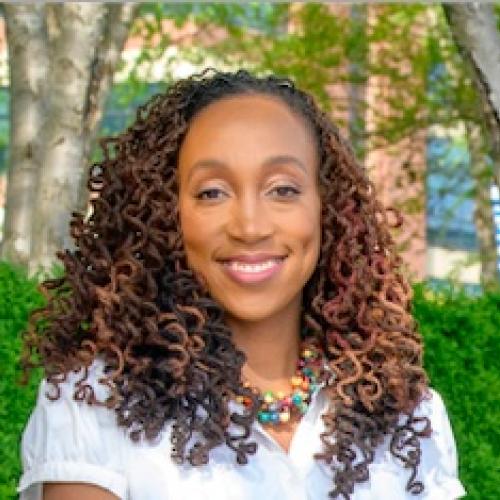
Mesi Bakari Walton, Ph.D. is an assistant professor in the Department of World Languages and Cultures at Howard University. Bakari Walton’s research intersects with Africana, Latin American, and Cultural Studies. Her work explores how Afro-diasporic cultures are employed as symbols of identity and tools of survival through cultural texts of music, song, dance, language, and other practices. Bakari Walton completed her Ph.D. in Afro-Latin Studies in the Department of African Studies at Howard University with a focus on Afro-Venezuelan Cultural survivals.
Bakari Walton was a U.S. Fulbright Scholar in Colombia and completed research titled, “Ancestral Identity - Afro-Colombian Cultural Traditions of the Atlantic Coast” and has publications on Venezuela and Colombia. Among them are the chapter “Dance, rhythm and ritual: Afro-Venezuelans in resistance” and an article titled “Women's collectives as a tool of agency in the Montes de Maria, Colombia." Bakari Walton teaches Spanish language and Afro-Hispanic culture courses in the Department of World Languages and Cultures. She also organizes cultural exchange tours throughout Latin America for youth and adults. Bakari Walton holds a master's in Spanish Language, a master’s in early childhood education, and a Bachelor of Science in Human Development from Howard University.
African Studies
Howard University
2019
Spanish Language & Linguistics
Howard University
2012
Early Childhood Education
Howard University
2003
Human Development
Howard University
2002
Art, Music & Dance in the Afro-Hispanic World is a course aimed at deepening student’s knowledge of the cultural practices and artistic expressions of people of the Hispanophone world. Lessons cover geography, history, politics, economy, society, music, dance, race, and art. The course highlights the cultural memory and practices of African peoples for each country through Art, Music and Dance. This course utilizes in-class discussion, lectures, student collaboration and presentations.
Hispanic Peoples and Cultures is a course aimed at deepening student’s knowledge of the sociopolitical institutions, literary and other cultural contributions of the peoples of the Spanish-speaking world. Lessons will cover geography, history, politics, economy, society, music, dance, race, and art. The course will highlight various forms of culture such as music, dance, attire, language and more through the lens of history, politics and society. The course will heavily focus on the cultural memory and practices of African peoples. This course will be a 3-credit course utilizing in-class discussion, lectures, student collaboration and presentations. The course will be taught in Spanish but some of the readings and films may be in English.
This is an intermediate language course designed for students familiar with Spanish grammar with the objective of improving Spanish oral skills in different communicative situations while acquiring a more profound understanding of Hispanic cultures. Students will learn how to express themselves in Spanish in formal and informal settings, practicing with speakers at varying levels while talking about a variety of topics, including science, sociology, films, music, and literature. Discover what makes a good narration, how to build a strong argument, what to say to structure an oral presentation, and how to expand or self-correct yourself during a conversation.
This is an intermediate language course designed for students familiar with Spanish grammar with the objective of improving oral expression. It emphasizes consolidation and expansion of the skills of oral fluency, and comprehension. In addition to focusing on spoken Spanish, the course uses short movies and readings to develop vocabulary and to practice discussing topics of interest in the Hispanic world.
The Humanities are academic disciplines that study the human condition. This course introduces students to the academic disciplines that promote a sense of humanity. During this semester, we will study literature, theatre, film, art, music, architecture, philosophy, and religion by critically thinking about moral values, myths, aesthetics, and liberty; all of this within African Diaspora frameworks. The goal is to analyze underlying assumptions about the way societies are formed and run and how societies express their ideas through these mediums. This course is designed to reawaken our sense of wonder and curiosity about the meaning of life. It shows how the various arts and sciences intersect, influence and are influenced by cultural and historical circumstances. Focus is on developing the conceptual tools to understand cultural phenomena critically.
Spanish 003 is the third level of four (4) sequentially taught language courses designed to satisfy the foreign language requirements of the College of Arts and Sciences. It is a three-credit undergraduate course that is offered in the Fall and Spring semesters and often during the summer.
Spanish 002 is the second level of four (4) sequentially taught language courses designed to satisfy the foreign language requirements of the College of Arts and Sciences. It is a three-credit undergraduate course that is offered in the Fall and Spring semesters and often during the summer.
Spanish 001 is the first level of four (4) sequentially taught language courses designed to satisfy the foreign language requirements of the College of Arts and Sciences. It is a three-credit undergraduate course that is offered in the Fall and Spring semesters and often during the summer.
Freshman Seminar (FRSM 001) at Howard University is a required 1-credit, pass-or-fail course designed to help first-year students transition smoothly into college life.
SPAN 890 Special Topics: Afro-Cuban Culture & Society will be a research, lecture, discussion and presentation-based course. This will be an interdisciplinary course delving into the cultures and society of Cuba from an Afro-Cuban perspective. The course will explore Spirituality, Dance, Music, land-based economies, freedoms, organizations and more. Students will be introduced to the historic and current cultures of Cuba, conduct research within their respective majors about Afro-Cuban communities, identify the ecological, economic, and social changes that have impacted those communities and present pre- and post-assessments and reflections related to both the course and the study abroad experience. Students will be required to use Spanish in reading, writing, listening, and speaking at their current level of fluency. The course will include an immersive Spanish language and cultural experiential learning experience for students who will travel to Cuba during Spring Break. The travel abroad is a mandatory component of the course. The course will serve as an Honors Lecture and an Experiential Learning Course.
Students of all levels of Spanish will be enrolled. Thus, each student is instructed to engage, listen and present at their level of the language during class sessions. Those at beginner level will hear a more advanced level from other students and guest speakers. They will improve their listening comprehension and speaking. Students who are at an intermediate/advanced level will read, write, and present in the target language. Class sessions will include the target language in all four modes of communication. Students will be able to communicate at a beginner level and beyond with community members.
SPAN 890 Special Topics: Afro-Colombian Society-Past and Present will be a research, lecture, discussion and presentation-based course. Students will be introduced to the historic and current cultures of Colombia, conduct research within their respective majors about Afro-Colombian communities, identify the ecological, economic, and social changes that have impacted those communities and present pre- and post-assessments and reflections related to both the course and the study abroad experience. Students will be required to use Spanish in reading, writing, listening, and speaking at their current level of fluency. The course will include an immersive Spanish language and cultural experiential learning experience for students who will travel to Colombia, South American towns, and cities, during Spring Break, March 7-14, 2024. The travel abroad is a mandatory component of the course. The course will serve as an Honors Lecture and an Experiential Learning Course.
Students of all levels of Spanish will be enrolled. Thus, each student is instructed to engage, listen and present at their level of the language during class sessions. Those at beginner level will hear a more advanced level from other students and guest speakers. They will improve their listening comprehension and speaking. Students who are at an intermediate/advanced level will read, write, and present in the target language. Class sessions will include the target language in all four modes of communication. Students will be able to communicate at a beginner level and beyond with community members.
Dr. Bakari Walton was awarded a U.S. Fulbright Scholar Award to conduct research in Colombia. She completed field research on the culture of a historic maroon region in the Atlantic of Colombia and how Ancestral Memory links to current identity of Afro-Colombians.
Institute for Citizens & Scholars - Career Enhancement Fellowship [Formerly named Woodrow Wilson Fellowship] (Fall 2025)
ACLS HBCU Fellowship (2026 - 2027)
“Afro-Venezuelan Culture in Motion: Ritual and Resistance in Migration”
Research location: Colombia
Afro-Colombia’s Bullerengue as a tool of Self-Determination
This article demonstrates that the Colombian town of María la Baja uses the dance, music, and song of bullerengue as a powerful tool to combat institutionalized racism. The community moved to teach and promote a dance traditionally performed by the elder population among the younger residents in an effort to maintain the custom and instill cultural and historical pride. Connected to a historic maroonage network, the people of María la Baja fought to reaffirm their identity through appropriately ethnocentered cultural knowledge and practices. Bullerengue has become a channel for community empowerment in conjunction with ethnoeducation and ancestral knowledge. By emphasizing their unique history, rich customs, and traditions, residents of María la Baja illustrate that a people can change otherizing narratives through self-determination.
Afro-Colombian Women’s Collectives as a Tool of Agency in the Montes de María Region
This study focuses on Black women’s collectives in the Montes de María regionof the Atlantic Coast of Colombia. Women serve as agents of change who improve the lives of their families and communities, as seen in the work of Vicenta Moreno Hurtado, who develops the idea that in response to trauma, Black women tell their stories as active agents of recovery and betterment. In this essay, the work of women’s collectives demonstrates the willpower to move through trauma and overcome daily and lifelong hardships.
Chapter 5: Dance, Rhythm, and Ritual: Afro-Venezuelans in Resistance in Fire Under My Feet: History, Race, and Agency in African Diaspora Dance
Fire Under My Feet seeks to expose the diverse, significant, and often under-researched historical and developmental phenomena revealed by studies in the dance systems of the African Diaspora.
Afro-Venezuelan Cultural Survival: Invoking Ancestral Memory
This study explores ways in which Afro-Venezuelans resisted oppression and survived by employing their knowledge, skills, and cultural memory. As a case in point, we examine the maintenance of Afro-Venezuelan cultural traditions in Barlovento, an area to which enslaved Africans were imported to work on large cacao estates and whose descendants now constitute the majority ethnic population in the region, with cultural traditions that uniquely identify it.