Master of Laws (LL.M.)
International Law (Intercultural Human Rights Law)
St. Thomas University
2003
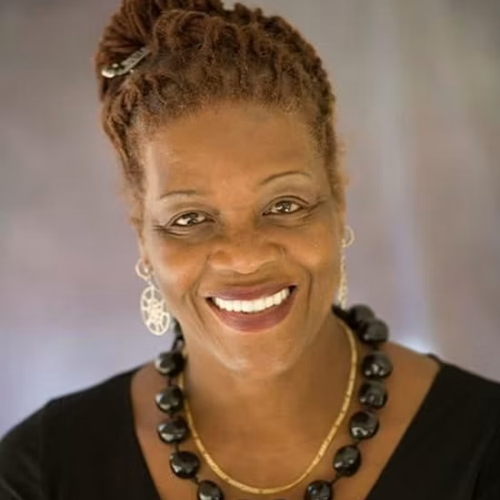
Carole Boyce-Davies is Chair of the English Department at Howard University and H.T. Rhodes Professor of Humane Letters emerita and Professor of Africana Studies and Literatures in English at Cornell University. She is the author of the prize-wining Left of Karl Marx. The Political Life of Black Communist Claudia Jones (2008); the classic Black Women, Writing and Identity: Migrations of the Subject (1994); Caribbean Spaces. Escape Routes from Twilight Zones (2013) on the internalization of Caribbean culture; and a bi-lingual children’s story Walking/An Avan (2016/2017) in Haitian Kreyol and English. In addition to over a hundred essays, articles published in major professional journals, Dr. Boyce-Davies has also published fifteen critical editions on African, African Diaspora and Caribbean literature and culture such as the two-volume collection of critical and creative writing Moving Beyond Boundaries (1995): International Dimensions of Black Women's Writing (volume 1), Black Women's Diasporas (volume 2); the 3-volume Encyclopedia of the African Diaspora (Oxford: ABC-CLIO, 2008) and Claudia Jones Beyond Containment: Autobiographical Reflections, Poetry, Essays (2011) and Pan-African Connections (2019) A member of the scientific committee for UNESCO’s updated General History of Africa, she edited the epistemological forum on “Global Blackness” for the African Diaspora volume and is a member of the Scientific Committee of the African Humanities Forum (based in Mali). Her most recent publication is Black Women’s Rights. Leadership and the Circularities of Power (2022/2023). She is a past president of the Caribbean Studies Association which organized under her leadership the first CSA Conference in Haiti in 2016. Her popular essays and reviews have appeared in The Guardian (London), The Washington Post, The Crisis, Ms Magazine, Ithaca Journal, The Black Scholar, Miami Herald, Trinidad Express, Trinidad Guardian, Caribbean Today, Caribbean Contact, Newsweek.
International Law (Intercultural Human Rights Law)
St. Thomas University
2003
English (African/Caribbean Literature)
University of Ibadan
1978
African Studies (Literature & Sociology)
Howard University
1974
English
University of Maryland, Eastern Shore
1971
Beyond the Kumbla: Sylvia Wynter and New Conversations
Beyond the Kumbla: Sylvia Wynter and New Conversations attests to the fact that the literary field dedicated to the study of Caribbean women’s writing, inaugurated by Out of the Kumbla: Caribbean Women and Literature (1990) flourishes and lives up to the excitement of its promise. Carole Boyce Davies and Elaine Savory have now co-edited a sequel volume, including a community of voices representing the field’s vibrant growth since 1990. Published here for the first time is the full extended essay Sylvia Wynter sent for the first book, necessarily limited then to a shortened Afterword. This now fully available long essay also links the past and present for Wynter’s theoretical and creative vision speaks to our current realities.
Black Women's Rights: Leadership and the Circularities of Power
Black Women's Rights: Leadership and the Circularities of Power presents Black women as alternative and transformative leaders in the highest political positions and at grassroots community levels. Beginning with a critique of the assumption of an equivalence between masculinity and political leadership, Carole Boyce Davies moves through the various conceptual definitions, intents, and meanings of leadership and the differences in the presentation of practices of leadership by women and feminist scholars. She studies the actualizing of political leadership in the Presidency of Ellen Johnson Sirleaf, the historical role of Shirley Chisholm as the first woman to run for presidency of the United States on a leading party ticket, the promise of the Black left feminist leadership of Brazilian Marielle Franco, and the current model of Prime Minister Mia Mottley of Barbados in advancing new leadership models from the Caribbean. This book proclaims the 21st century as the century for Black women's leadership.
Pan-African Connections brings to the reader a combination of Reflections and Testimonies from writers, politicians, activists, colleagues; with essays on intellectual activism, the building of Pan-African institutions and the voices of women in Panafricanism. Stories abound from writers such as Ngugi wa Thiong’o and Anyang’ Nyong’o about Locksley Edmondson, who is featured here, who like Walter Rodney, lived and worked on the African continent physically, but also engaged it politically, culturally and intellectually in teaching and research. The lives and work of these scholars embodied precisely the bringing together of African, Caribbean and African-American Studies in the intellectual arena. Through this generation of intellectual/activists, the rubric of Panfricanism remains one of the key areas of academic and political inquiry in Africana Studies.
In this sweet coming-of-age tale, Carole Boyce Davies captures the legend of a man on a secret mission to speed walk around his majestic Caribbean island. But is this rapid moving rebel a madman or are we the crazy ones for standing still while life passes by? Is our speed walker a man ahead of his time? Get ready, get set to go on a high speed tour of your favorite Caribbean island, seen through the eyes of a Caribbean girl.
Chapter 9: A Geneaology of Black Left Feminist Claims in Black Feminist Constellations. Dialogue and Translation Across the Americas
In essays, poems, and dialogues, the writers in Black Feminist Constellations reimagine liberation from the perspectives of radical South American and Caribbean Black women thinkers. The volume’s methodologically innovative approach reflects how Black women come together to theorize the world and challenges the notion that the university is the only site where knowledge can emerge. A major work of intellectual history, Black Feminist Constellation samplifies rarely heard voices, centers the uncanonized, and celebrates the overlooked work of Black women.
Chapter 3: A Right to be Radical: Claudia Jones (1915–1964) and the ‘Super-Exploitation of the Black Woman’ in The Palgrave Handbook of Communist Women Activists around the World (pp. 97-116)
Claudia Jones was the leading theoretician on the conjuncture of women’s rights, workers’ rights, and Black rights in the Communist Party USA from 1945 to 1955. She theorized the super-exploitation of women, using the Black woman’s economic location in society, advancing the Marxist super-exploitation thesis by calling for "An End to the Neglect of the Black Woman" in Communist Party analyses of the working class and organizing networks but also in its leadership structures. One sees in Claudia Jones’s thinking and activism the advancement of Black women as leaders in struggles for freedom, worldwide.
Chapter 26: The Transnational Black Feminist Poetics of Claudia Jones in The Routledge Companion to Black Women’s Cultural Histories
In the social and cultural histories of women and feminism, Black women have long been overlooked or ignored. The Routledge Companion to Black Women’s Cultural Histories is an impressive and comprehensive reference work for contemporary scholarship on the cultural histories of Black women across the diaspora spanning different eras from ancient times into the twenty-first century. Comprising over 30 chapters by a team of international contributors, the Companion is divided into five parts:
Within these sections, a diverse range of women, places, and issues are explored, including ancient African queens, Black women in early modern European art and culture, enslaved Muslim women in the antebellum United States, Sally Hemings, Phillis Wheatley, Black women writers in early twentieth-century Paris, Black women, civil rights, South African apartheid, and sexual violence and resistance in the United States in recent history.