
Doctor of Philosophy (P.h.D.)
French Language and Literature
Boston University
2012
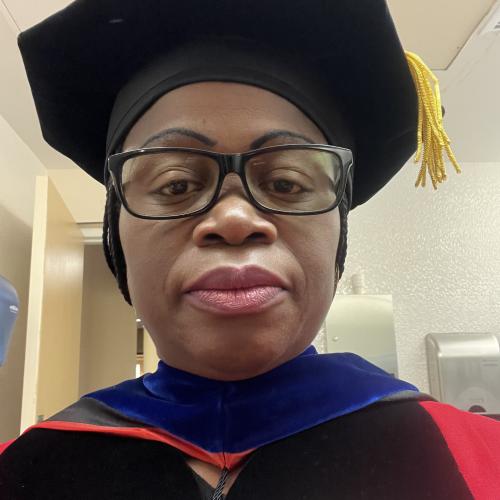
Ariane Ngabeu, Ph.D. is an Assistant Professor of French and Francophone Studies in the Department of World Languages and Cultures at Howard University. She holds degrees from the University of Yaoundé I and Boston University, where she was a five-year recipient of the prestigious Presidential Fellowship (2007–2012). Dr. Ngabeu brings extensive academic, intercultural, and administrative experience to her teaching and research and has been recognized for her outstanding scholarship with the Faculty Research Award and Faculty Scholar Award at Howard University (2025–2026).
From 2012 to 2023, she served as the inaugural Resident Director of the Middlebury College School Abroad in Cameroon, where she designed and led immersive study abroad programs for undergraduate and graduate students from across the United States. Her work emphasized intensive French and Medumba language acquisition, cultural immersion, and meaningful engagement with local communities.
Dr. Ngabeu’s scholarly interests include Francophone Studies, Gender Studies, culture and identity, history and memory, tradition and modernity, migrant narratives, postcolonial and feminist theories, and digital media, including film, television series, visual arts, and artificial intelligence. She is the author of Les Enjeux de la modernité dans le roman africain au féminin (2021) and a contributor to Le Dictionnaire universel des femmes créatrices (2013). Her publications include numerous essays and book chapters exploring gender and migration, postcolonial identities, memory, and sociocultural transformation in African and diasporic contexts.
Her current research focuses on digital cinema, artificial intelligence, video films, and television series as agents of social critique and social transformation in contemporary Cameroon. Her project, “Digital Voices: Rethinking Cameroonian Cinema in the Age of Technology and Artificial Intelligence,” has received growing recognition, including her selection as a finalist for the ACLS HBCU Faculty Fellowship and Grant Program and the award of a research grant in 2026 in support of this work.
Among her earlier distinctions, Dr. Ngabeu received the Essay Prize Award (May 2012) from the Department of Romance Studies at Boston University, granted annually to a doctoral student for excellence in writing.
French Language and Literature
Boston University
2012
African and Caribbean Literature
University of Yaoundé I
2007
African and Caribbean Literature
University of Yaoundé I
2004
African and Caribbean Literature
University of Yaoundé I
2001
This course invites students to explore the rich world of Francophone African digital cinema, with a special focus on Senegal. We will look closely at how films and web series—ranging from Ousmane Sembène’s groundbreaking political works to today’s independent digital productions—offer windows into questions of gender, identity, power, and cultural belonging.
Throughout the semester, we will pay special attention to digital works such as Maudite infidélité and Lady Diama, which navigate themes like patriarchy, marriage, betrayal, domestic conflict, female agency, masculinity, and silence. These productions highlight how digital platforms like YouTube have opened up new spaces for storytelling, allowing marginalized voices to challenge traditional norms and spark conversations about gender, intimacy, and social change in contemporary African society.
Through film analysis, theoretical exploration, and thoughtful discussion, students will learn to see digital cinema not just as entertainment, but as a cultural archive and tool for social transformation. A Spring Break study-abroad immersion in Senegal will allow students to meet filmmakers, digital creators, and cultural practitioners firsthand, linking theory with lived experience. By the end of the course, students will have the tools to critically engage with how Francophone African digital cinema reflects, challenges, and reimagines gender and identity today.
“Digital Voices: Rethinking Cameroonian Cinema in the Age of Technology and Artificial Intelligence.” Finalist for the ACLS HBCU Faculty Fellowship and Grant Program. $500 grant in support of this research. 2026.
Awarded to one doctoral student each year for excellence in writing work, Department of Romance Studies, Boston University.
Read: Harvard Gazette | At a loss for words
Foundations and historical changes in African literatures in L'industrie du livre en Afrique: tendances, défis & opportunités de croissance (The African book industry: trends, challenges & opportunities for growth)
Most early African literatures were essentially oral, and were expressed in a variety of local languages. This oral tradition, teeming with various genres including epics, tales, and proverbs, was a primary vehicle for transmitting knowledge, collective memories and cultural values. Today, this "oraliture" is fully recognized as a cultural expression and as a legitimate and valuable source of African history, carrying with it the richness of an intangible heritage that has long been neglected.
Gender-Based Violence in Cameroon’s Digital Cinema in Rocky Mountain Review, Spring 2025, Volume 79, number 1 (pp. 23-41)
Blaise Ntedju, a Cameroonian digital filmmaker and creator of online streaming platforms, addresses gender-based violence in 12 Cas(2024), a series depicting twelve cases of rape. This research examines the final case, Secret mortel, Cas 12(Deadly Secret, Case 12), exploring how digital visual art intersects with societal issues in Cameroon. By incorporating everyday realities into his narratives, Ntedju highlights challenges such as family conflicts, betrayal, incest, and rape-induced pregnancies.
Migration, Water, and the Human Condition in Laurent Gaudé’s Eldorado in Journal of Comparative Literature and Aesthetics Vol. 48, No. 3, Autumn, Vishvanatha Kaviraja Institute, India, 2025, pp. 65-73.
In Eldorado, Laurent Gaudé transforms the Mediterranean into a space where personal desire and collective crisis intersect. Through Soleiman, a young African migrant pursuing dignity, and Salvatore Piracci, an Italian coast guard consumed by moral doubt, the novel portrays migration as both human struggle and political dilemma. Rejecting abstraction, Gaudé foregrounds the voices, silences, and bodies of those in motion, exposing the violence of borders and the fragility of resilience. This article, drawing on postcolonial theory and migration studies, argues that Eldorado compels us to confront the ethical stakes of displacement while restoring humanity to its narratives.
Les Enjeux de la modernité dans le roman africain au féminin (Issues of Modernity in African Female Novel)
This essay revisits the treatment of modernity in Francophone postcolonial Africa through the novels of Ken Bugul, Werewere Liking and the late Angèle Rawiri. The study examines how these authors represent the current problems of African identity. The analysis also looks at the dilemmas of female characters and the realities of African women to rethink social problems. To get out of this ambiguity, this essay suggests that the multicultural context should be constantly taken into account to build one's identity according to the cultures present.
Violence conjugale et figures féminines chez Djaïli Amadou Amal (Domestic Violence and Female Figures in Djaïli Amadou Amal’s Works)
This work aims to analyze the complex dimensions of marriage and the manifestations of domestic violence in Africa. To understand the link between marriage and female violence, we will draw on Pierre Bourdieu’s theory, which defines the power dynamic between men and women as a form of ‘symbolic violence’. The objective will be to examine the strategies employed to express this violence in Djaïli’s work. The study of the female characters will help us better grasp the unique aspects of the author’s writing while also highlighting the similarities with other African women.
Despite limited resources, digital cinema benefits from wide dissemination through social media and online platforms, making it a powerful medium for addressing complex issues. Femme sadique by Blaise Ntedju and La Nouvelle Épouse by Marcelle Kuetche illustrate the complexity of gender relations and conflict management in Cameroon. These films use domestic spaces as symbolic arenas where gender conflicts unfold. Although dramatic, they offer an essential platform for discussing the challenges faced by both men and women. Through strong female characters and tense situations, these works question social norms and provide a reflection on power relations, inequalities, and the contradictions within traditional systems. While these films explore tensions between traditional values and women’s modern aspirations for autonomy, female actions (such as sadism and rebellion) can be perceived as forms of resistance to oppressive norms. This study examines how, in the digital age, Cameroonian filmmakers address power dynamics and gendered conflicts in their artistic productions.
This article offers a cross-reading of So Long a Letter by Mariama Bâ and The Belly of the Atlantic by Fatou Diome to show how writing becomes a space of resistance and emancipation. The heroines, confronted with various forms of confinement, patriarchal, social, cultural, and diasporic, refuse silence by inventing strategies of survival and self-reinvention. Drawing on postcolonial feminism as well as carceral and diasporic studies, the analysis highlights narrative voices that restore visibility and dignity to subaltern women. Exile, experienced as an intimate rupture, thus becomes a site of subject formation and identity affirmation.