
Doctor of Philosophy (Ph.D.)
Classics
Columbia University
1990
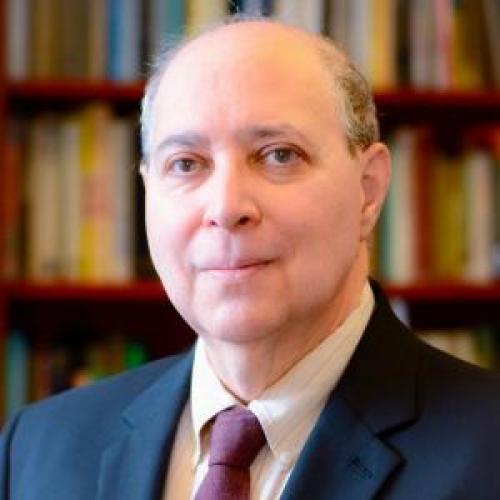
Alexander Tulin, Ph.D., is an associate professor in the Department of English at Howard University in Washington, D.C. He earned his doctorate, Master of Philosophy and Master of Arts degrees from Columbia University and received a bachelor’s degree with honors from the State University of New York at Purchase. Tulin joined Howard University in 1990 and has served on the faculty for more than three decades, holding appointments in both the Department of Classics and the Department of English. He previously served as chair of the Department of Classics and chair of the Humanities Division.
Tulin’s research and teaching interests span classical studies, modernism, American literature, rhetoric, ancient philosophy and the intersections between antiquity and modernity. He has published on topics in Ancient Greek Philosophy, Plato, Ancient Law, Rhetoric, and is currently interested in the cross-cultural interstices between Antiquity and Modernity.
From 2017-2021, he was the Chair of the Department of Classics. But with the closing of Classics in 2021, Dr. Tulin is now in the Dept. of English, where his primary teaching interests are in Modernism, modern art from 1870-1950, and in the 20th century novel in Europe and America.
For all publications (in .pdf format), see: https://alexandertulin.wordpress.com
Classics
Columbia University
1990
Columbia University
1986
Columbia University
1984
State University of New York, College at Purchase
1984
Specialty Areas: Ancient Homicide Law, Ancient Philosophy, American Literature, Crime Fiction and 20th Century 'Noir', Modernism, 1870-1945 (Literary and Cultural), Modernist Art, Rhetoric (Ancient and Modern)
Dike Phonou: The Right of Prosecution and Attic Homicide Procedure
The normal means of seeking redress in Athenian law was through a dike, which the victim brought to the appropriate magistrate, who then conducted the case through the various stages of the Athenian legal process, an initial inquiry, possibly a public arbitration, and finally a trial before a democratic court. What distinguishes homicide from almost every other offense, however, is precisely that its victim cannot seek legal redress because he is dead. So who does?
This short book is devoted to the single aim of supporting the “traditional view” that it was only the members of the victim’s family who had the right to seek this redress through a suit for murder (dike phonou). In a wider-ranging book (almost as short as this one, Athenian Homicide Law in the Age of the Orators), Douglas MacDowell argued in 1963 against that restrictive interpretation: though Athenian law enjoined the relatives (or in the case of a slave, the owner) of the victim to prosecute, it did not order others not to. Others have since followed MacDowell’s lead. Tulin relies on three disparate pieces of evidence, to each of which he devotes one chapter: Drakon’s Code and Plato’s Euthyphro.
On the Refutation of Polemarchus: Analysis and Dialectic in Republic I
This paper contains a detailed examination of an important passage in Republic Book I, and seeks to demonstrate that analysis (as opposed to synthesis) originated in Plato’s use of dialectic. This paper then demonstrates, to the extent that demonstration in such matters is attainable, that Republic I was from the outset conceived as a prologue to the dialogue as a whole, and that it was not itself an independent dialogue tacked on to the rest at a later stage. In both cases the claim is made that the proofs advanced are more or less definitive.
Please Remind Me of Anamnesis: A Double-Entendre in Plato’s Phaedo
Slave Witnesses in Antiphon V.48
A Note on Euripides’ Bacchae 39-42
Xenophanes Fr. 18 D.-K. and the Origins of the Idea of Progress
Participant in ACLS Conference on Recently Tenured Faculty in the Humanities (April 2001). "Homicide and the Sociology of the Ancient Family.”
Lecture presented by invitation to the ‘Program in Research Investigations’ at St. Mary’s College. [PRISM], July 23, 1997
"Dike Phonou: Attic Homicide Procedure and the Problem of Plato’s Euthyphro.” (Paper presented by invitation to the ‘Workshop-Conference on Reason and Religion in Fifth-Century Greece,’ Univ. of Texas, Austin. Respondent: M. Gagarin. Sept. 21, 1996)
Moderator for a panel discussion on Ancient History (The Classical Association of the Atlantic States [CAAS], Dickinson College, May 1994)
"Plato and Socrates" (Howard University, Humanities Div. Faculty Workshop, Aug. 1993)
"Platonic Self-Examination and the Allegory of the Cave." (Guest Lecturer for the Howard University, Division of Humanities’ NEH sponsored seminar, June 1992)
"Euthyphro's Homicide Case." (APA, Chicago, Dec. 1991)
"Euthyphro's Homicide Case." (Paper presented to the George Washington Univ. Seminar on Ancient Mediterranean Cultures. Respondent: P.Wakefield. Dec. 11, 1991)
"Xenophanes Fr. 18 DK, and the Origin of the Idea of Progress." (The Classical Association of the Atlantic States [CAAS], Fordham University, Sept. 1991)
"Catullus 1 and the Hellenistic Origins of Neoteric Poetry." (Providence College, Feb. 1991)
Respondent to J. H. Lesher: "Xenophanes' Fr. 18 as 'Faith in Progress'." (GWU Seminar on Ancient Mediterranean Cultures, Oct. 1990)
"Stoicism and the Doctrine of Life According to Nature." (Contemporary Civilization Faculty presentation, Columbia Univ., Oct. 1989.)
"The Bible and the Hellenic Roots of the Western Tradition." (Contemporary Civilization Faculty Initiation, Columbia Univ., Sept. 1988.)