
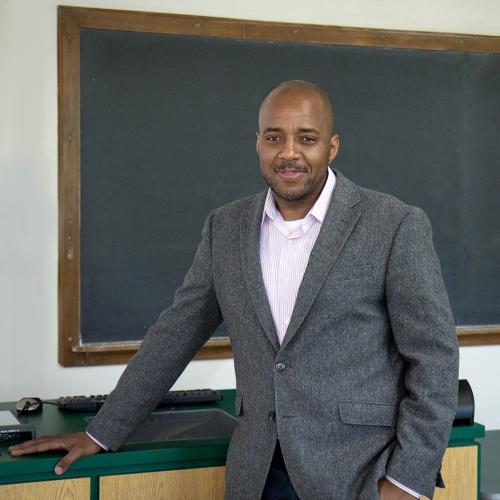
Lemir Teron
Associate Professor
Department/Office
- Environmental Studies
School/College
- College of Arts & Sciences
Biography
Lemir Teron is an associate professor in the Department of Earth, Environment and Equity. He holds a PhD in Energy & Environmental Policy from the University of Delaware and completed a NOAA funded postdoc at Florida A&M University’s Environmental Cooperative Science Center.
His work is committed to advancing public science and environmental justice, with research interests that include environmental health, energy policy and urban & community forestry.
Dr. Teron has received numerous accolades, including being awarded: the 2019 Distinguished Faculty Member for Teaching Excellence Award by the SUNY ESF Undergraduate Student Association, a 2020 Unsung Hero Award at Syracuse University’s 35th Martin Luther King Jr. Celebration and a 2022 Champion of Diversity by the YWCA of Syracuse and Onondaga County (NY).
Dr. Teron serves on the Maryland Commission on Environmental Justice & Sustainable Communities and served on the NY State Climate Impacts Assessment’s Energy Workgroup. He is a member scholar at the Center for Progressive Reform. He was named a 2022-2023 Nathan Policy Fellow at the Rockefeller Institute of Government.
Academics
Academics
Featured News
Featured News
2026 Book Release
Unlearn Power: Strengthening Communities in the Age of Environmental Crisis (Bloomsbury)
Unlearn Power: Strengthening Communities in the Age of Environmental Crisisexamines how environmental inequality undermines ecosystems and the livelihoods of inhabitants while weighing approaches to resistance and advancing community security. Prefaced on the figurative and literal question "what's under the hood?", the text explores a range of contemporary disparities and threats - endemic across environments and societies - rooted in socioeconomic inequality and systemic racism.
Building on the author's work in urban forestry, environmental planning, and energy policy, Unlearn Power applies a range of analysis approaches, frameworks, and case studies to make its case for the democratization of environmental decision-making through the centering of marginalized communities and elevating labor as focal points.
As serious questions persist related to how the potential of energy and environmental transitions can be reached, without rooting restorative justice and life cycle analysis in environmental governance, the objectives of pro-climate and environmental movements will be deficient. The book ultimately calls for the rethinking of power - including both energy systems and political structures - to advance ecological and human well-being.