Postdoctoral Fellow
Georgia Institute of Technology
2008

Gbadebo Moses Owolabi, Ph.D. is a full professor and the director of Graduate Studies in the Department of Mechanical Engineering. He obtained his Bachelor of Science (First Class Honors) degree from the Obafemi Awolowo University, Nigeria and his doctorate from the University of Manitoba, Canada. Prior to joining Howard University, he was a Visiting Research Scholar at Georgia Institute of Technology sponsored by the Government of Canada through the Prestigious Natural Science and Engineering Research Council of Canada Postdoctoral Fellowship.
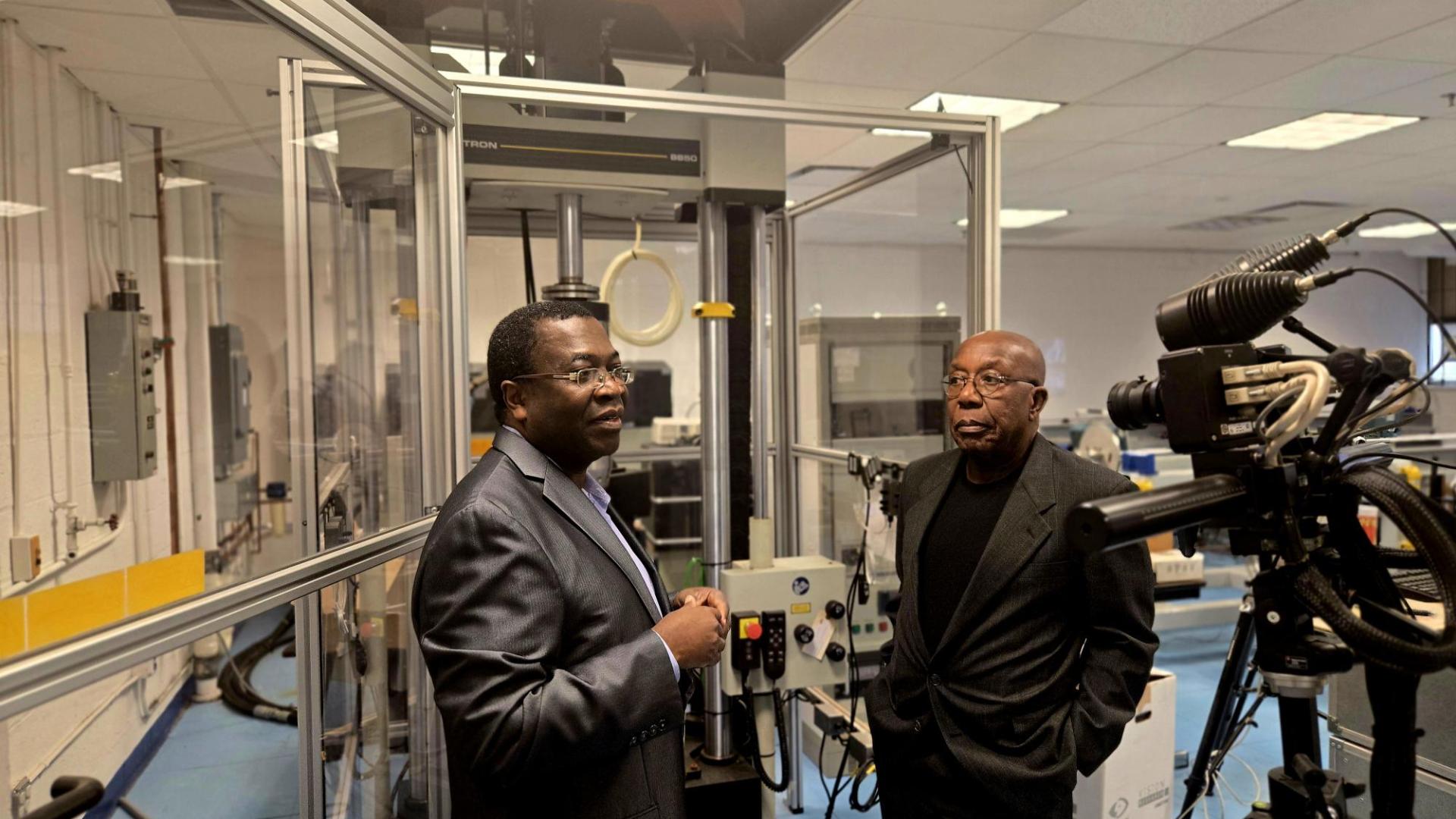
Owolabi is the founding director of the Applied Mechanics and Materials Research Lab (AMMRL) at Howard University. AMMRL supports research activities in the areas of materials processing, testing, and characterization for advanced materials at various strain rates and temperatures. AMMRL is equipped with state-of-the-art instruments including split Hopkinson pressure bars, biaxial thermomechanical test systems and ultra high-speed digital cameras with frame rate of 7 million frames per second.
Owolabi is a well-established researcher in the fields of mechanics of materials and materials science and engineering. He has performed numerous studies on the deformation, fatigue, and fracture of materials used in a variety of applications. His expertise in the field of materials science adds a unique multidisciplinary flavor to his research. The principal goal of his current research is to investigate process-microstructure-property relationships in nanostructured, ultrafine grained, and additively manufactured metallic alloys. He is also studying the effects of heat treatment and grain refinements on the deformation mechanisms and mechanical performances of multi-principal alloys produced via additive manufacturing (AM). The growing number of applications of AM alloys highlights the importance of understanding mechanical performances of these materials under various loading conditions and extreme environments, an area where very limited research studies have been conducted. The combination of his expertise and AMMRL resources provides a unique opportunity for developing innovative technological solutions that would advance the adoption and implementation of the emerging advanced manufacturing technology into several applications in the aerospace, automotive, and defense sectors.
Owolabi has secured over $20 million research grant awards as principal investigator and co-principal investigator from the Department of War, the Air Force Office of Scientific Research, the Army Research Office, National Science Foundation, and the Department of Energy to support his research activities in the area of additive manufacturing, fatigue and fracture mechanics at various scales, high strain rate testing and material characterization, structural integrity and health monitoring. In the area of structural integrity, Owolabi and his team have developed novel simulation-based strategies for predicting the formation and growth of small cracks in advanced materials and structures for numerous applications in large-scale industries including aerospace, ship/marine structures, pressure vessels, and other applications where fatigue is a critical issue in reliability analysis. Owolabi’s research findings have been published in over 100 articles in leading international journals and conferences proceedings and four book chapters. He has also supervised several postdoctoral fellows and masters/doctorate students as well as undergraduate researchers.
Owolabi is a Fellow of the American Society of Mechanical Engineers (ASME). As stated on ASME website “The ASME Committee of Past Presidents confers the Fellow grade of membership on worthy candidates to recognize their outstanding engineering achievements.” Owolabi was a member of the National Academies of Science, Engineering, and Medicines committee formed in summer 2020, following congressional direction to NASA, to perform an independent review of NASA’s University Leadership Initiative (ULI) and recommend options for strengthening the initiative.
Georgia Institute of Technology
2008
Mechanical Engineering
University of Manitoba
2005
Mechanical Engineering
Memorial University
2001
Mechanical Engineering (First Class)
Obafemi Awolowo University
1997
Consortium for Research and Education for Advanced Manufacturing of Alloys for Extreme Conditions (REAM). Department of Energy’s National Nuclear Security Administration (DOE-NNSA). $4,700,000 (in collaboration with TSU and Texas A & M). 2026-2031.
Enhanced Microstructures and Mechanical Performances of Additively Manufactured Metallic Alloys (GRT000573). Department of Defense (DOD). $794,000. 2023-2027.
Acquisition of Ultra-High-Speed Deformation and Strain Measurement System. Department of Defense (DOD). $600,750. 2024-2025.
Leading Advanced Turbine Research for Hybrid Electric Propulsion Systems NASA (ULI). $8,000,000 (in collaboration with Penn State and GT). 2021-2027.
Additive Manufacturing Post-Processing Partnership. Department of Energy (DOE)/NNSA. $3,000,000 (in collaboration with UDC, MSU and Lincoln University). 2019-2023.
Novel Methods for Fatigue Life Prediction for Turbine Engine Components. Air Force Research Lab. $400,000. 2017-2022.
Extending Advanced Manufacturing Post-Processing Activities through Acquisition of an Additive Manufacturing System Suite. Department of Defense (DOD). $596,000. 2021-2023.
Optimizing the Dynamic Response of Ultrafine Grain and Hybrid Alloys under Impact Loading. Department of Defense (DOD). $596,225. 2015-2019.
Vibration-Based Cleaning for Ash Removal from Diesel Particulate Filters. NSF-Filter Sensing Technology. $70,000. 2015-2016.
Dynamic Failure of Aluminum-Based and Polymer Matrix Composites at High Strain Rates. DOD - Army Research Office. $514,515. 2012-2016.
Microstructure-Sensitive Fatigue Design for Notched Components. Air Force Office of Scientific Research (AFOSR). $479,517. 2011-2014.
Acquisition of a Biaxial Tension-Torsion Testing System to Advance Research, Education, and Training at Howard University. AFOSR- Defense University Research Instrumentation Program (DURIP). $525,000. 2012-2014.
Acquisition of a Biaxial System to advance research, education, and training at Howard University. National Science Foundation. $367,000. 2012.