Doctor of Philosophy (Ph.D.)
Languages and Literatures of Spanish & Portuguese
The University of Texas at Austin
2014
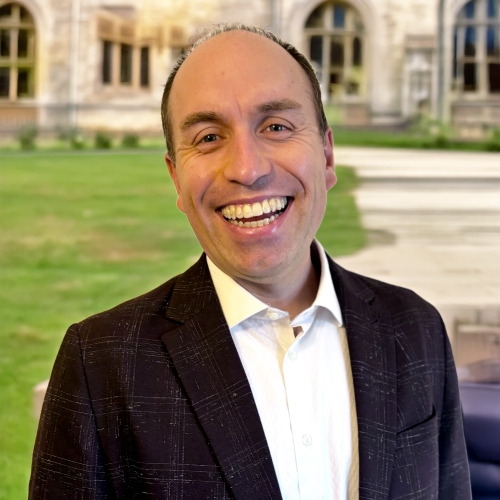
Eliseo Jacob, Ph.D. is a senior lecturer in the Department of World Languages and Cultures. He is an interdisciplinary scholar whose work bridges digital humanities, race, and cultural expression across Brazil, Latin America, and the African diaspora. His research focuses on how popular culture—such as hip-hop, artivismo (art activism), and digital media—serves as a tool for political engagement, community building, and transnational dialogue among marginalized communities.
He earned his Ph.D. in Spanish and Portuguese from The University of Texas at Austin, developing research on literary and cultural productions framed by citizenship, masculinity, and public space in São Paulo’s urban periphery. His scholarship spans Afro-Brazilian literature, poetry, and urban cultural production, analyzing how artists and activists use creative expression as a form of resistance to systemic inequality. His work draws on postcolonial theory and racial justice to examine social movements across Latin America that center marginalized identities through the cultural arts
Jacob has received prestigious awards such as a U.S. Fulbright Scholar Award to Brazil and a fellowship from the American Council of Learned Societies (ACLS), supporting his research on race, digital media, and urban activism in Latin America. He has presented at international conferences including the Latin American & Caribbean Digital Humanities Symposium and the International Conference on Transcultural Hip-Hop and has contributed to digital archives and platforms highlighting Afro-Latin American art and activism.
At Howard University, he teaches courses on race, citizenship, and technology in Latin American literature and culture, and mentors students in using digital tools to study global Black cultural production. His ongoing projects explore the public sphere in Latin American urban culture, the political role of poetry and literature in peripheral communities, and the integration of digital methods in humanities pedagogy. Through his teaching and research, he fosters connections between scholarship and activism, emphasizing the intersections of race, identity, and technology in the contemporary world.
Languages and Literatures of Spanish & Portuguese
The University of Texas at Austin
2014
Luso-Brazilian Literature & Culture
The University of Texas at Austin
2009
Latin American Studies
The University of Texas at Austin
2007
Specialty Areas: Latin American Urban Cultural Studies, 20th-21st Century Latin American Literary & Cultural Productions
Digital Humanities:
Latin American Studies:
Foreign Language:
Afro-Brazilian International Immersion Series, COAS Honors Program, 2023-2024
Brazilian Hip Hop Series, Department of World Languages & Cultures, Fall 2020
Dr. Jacob was awarded an inaugural American Council of Learned Society (ACLS) HBCU Faculty Grant. to develop the digital humanities project Afro-Artivismo: Activist Cultural Practices in Urban Spaces. The project interrogates the dynamic relationships between race, space, and citizenship and uses the Scalar digital platform to create an interactive, multimodal site for users to better understand the role of the arts as a form of community engagement in addressing state violence and preserving cultural practices in the working class, outskirt communities of São Paulo, Brazil.
Dr. Jacob was awarded an American Council of Learned Societies (ACLS) Fellowship for the 2022-23 academic year. He will use the fellowship to complete his monograph Masculinidades Marginais: Race, Gender, and Citizenship in São Paulo, which uses the theoretical framework of counterpublics to analyze contemporary literary productions from the city's historically marginalized communities with a focus on masculinity and race in urban settings.
Dr. Jacob was recently awarded a Fulbright U.S. Scholar Award for the 2021-22 academic year to conduct research in Brazil. He will conduct a research project on writing communities in the urban periphery of São Paulo and collaborate with faculty at the University of São Paulo.
HU Você Sabe!: Exploring Portuguese at Howard University
Theater of the Sacred: Resistance in the Zona Sul
Allan da Rosa and the Creation of a Radical Afro-Brazilian Imagination. Revista de Estudos de Literatura Brasileira Contemporânea, vol. 68 (2023).
By creating a literature rooted in the experiences of Afro-Brazilians living in São Paulo's peripheral communities, writer Allan da Rosa articulates an imaginative space for marginalized black residents as a way to escape poverty and racism. This article frames the author's analysis of Allan da Rosa's literary works Zagaia (2007) and Da Cabula (2008) through the lens of Robin D. G. Kelley's concept (2003) of the Black radical imagination to examine how liminal spaces found in São Paulo's urban periphery become the impetus for social change. Imagination as a social practice plays a key role in the black public sphere, as Afro-descendent communities look to other historically imagined times for inspiration to conceive a future rooted in freedom. Based on these two literary works, this article analyzes the role of the imagination in the black public sphere from which Allan da Rosa's discourses emerge in terms of how his protagonists inhabit liminal spaces that continually fluctuate between the reality of urban life and the metaphysical. The purpose of this article, therefore, was to demonstrate through Zagaia and Da Cabula that the author belongs to this tradition of engaging in the Black radical imagination as a political strategy that not only resists racial and social inequity but seeks out solutions to empower afro-descendent communities through creative strategies of cultural affirmation and social mobilization.
Binho: Poetry as Social Practice in the Periferia of São Paulo. Middle Atlantic Review of Latin American Studies, vol. 5, no.2 (2021).
Presentation of the Brazilian poet and cultural promoter Binho (Robson Padial) with a selection of his poetry
The Organic Intellectual and the Bandido: The Periferia as a Site of Black Civic Engagement in Ferréz’s Manual prático do ódio. Itinerários – Revista de Literatura Brasileira, n. 46 (2018).
In this work, I argue that Ferréz's romance, Manual prático do ódio, functions as an alternative public sphere, or a black “counter-public”, where the problems of peripheral youth are only addressed and criticized through two archetypes: the bandit and the organic intellectual. These two archetypes represent a dichotomy of reactions to an unjust world that surrounds peripheral youth: the temptation of money and power through drugs and violence versus the possibility of social entrapment through cultural projects that celebrate African ancestry. The illusion of power incorporated by no bandit raises doubts about the permanence of crime as an immediate solution to social inequality. Functioning as a catcher to a bandit and his gang, suddenly a figure, who is out of place, appears: the organic intellectual. This figure plays a small role, but its positioning in a space outside of place within the periphery allows us to see the value of its community through the culture and history of its ancestors, thus incorporating what Paulo Freire defines as a critical consciousness. Therefore, the tension between these two figures functions as a debate within the counter-public of the periphery about what is the best line of action in terms of offering urban youth legitimate options to empower themselves.
Peripheral Rhizomes: Reterritorialization and Urban Space in Sacolinha’s Estação Terminal. Ipotesi: Revista de Estudos Literários 21.1 (2017).
This article will examine the representations of the non-romance terminal Estação Terminal de Sacolinha, and will argue that the romance frames reterritorialization as a process in which marginalized personas negotiate spaces controlled by state through rhizomatic networks
Senzalas e Quilombos Modernos: Evoking the Legacy of Slavery in Brazilian Hip-hop in Trajectories of Empire Transhispanic Reflections on the African Diaspora. Edited by Jerome C. Branche. Vanderbilt University Press (2022).
Trajectories of Empire extends from the beginning of the Iberian expansion of the mid-fifteenth century, through colonialism and slavery, and into the twentieth and twenty-first centuries in Latin American republics. Its point of departure is the question of empire and its aftermath as reflected in the lives of contemporary Latin Americans of African descent and of their ancestors in the historical processes of Iberian colonial expansion, colonization, and the Atlantic slave trade.
The book’s chapters explore what Blackness means in the so-called racial democracies of Brazil and Cuba today. Among the historical narratives and themes it covers are the role of medical science in the objectification and nullification of Black female personhood during slavery in nineteenth-century Brazil; the protocols of portraiture in the colonial period that, in including enslaved individuals, pictorially highlight and freeze their supposed inferiority vis-à-vis their owners; and those aspects of discourse that promote colonial capture and oppression in terms of evangelization and the saving of souls, or simply create the discursive template as early as the fifteenth century, for their continued alienation and marginalization across generations.
Black Lives Matter in Brazil: Cidinha da Silva’s #Parem de nos matar. Améfrica in Letters: Literary Interventions from Mexico to the Southern Cone. Edited by Jennifer Carolina Gómez Menjívar. Vanderbilt University Press (2022).
Traditional histories of Black letters in Latin America have delimited their geographic scope to the Caribbean while also omitting intertwined Afro-Indigenous discourses. Inspired by the legacy of Amefrican thinker Lélia Gonzalez, Améfrica in Letters highlights the Black poets, songwriters, novelists, essayists, and bloggers who have created a counter-multiculturalist literary history on the Latin American mainland. To capture a sense of the variety of their contributions, this book spans Mexico, Central America, the Andes, and the Southern Cone—highlighting the transcontinental nature of the legacy of Black writing and its impact beyond national boundaries. The writers examined in the volume engage with regional intellectual frameworks while putting into circulation a demand for a recalibration of the Hispanophone and Lusophone contexts in which they and other Afrodescendants reside.
The History of Black Writing Novel Corpus: Digitization, Infrastructure, and Collocation as Social Practice (Co-authored with Marina del Sol) in English Language Literatures: Interdisciplinary Readings (pp 111-121). Edited by Maria Aparecida Salgueiro and Vanessa Cianconi. Letra Capital (2021).
This article considers how using a full-text search and retrieval tool, PhiloLogic, to navigate the space of a Black digital archive can effectively locate trends and draw attention to African American writers who have collectively and individually impacted literary studies.