Doctor of Philosophy (Ph.D.)
Political Science
Howard University
1997
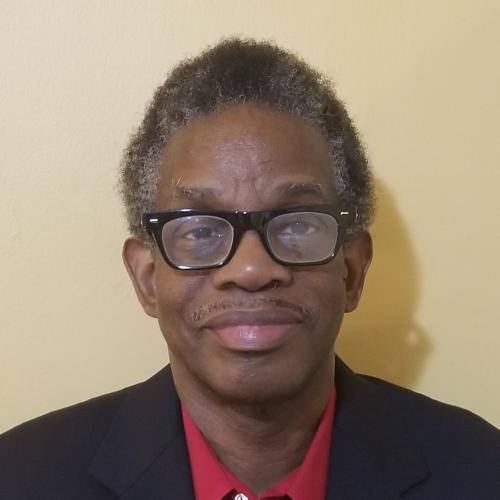
Clarence Lusane, Ph.D. is a full professor, former chairman of Howard University’s Department of Political Science, and current director of the International Affairs program. He is an author, activist, scholar, lecturer, and journalist. For more than 40 years, he has written about and been active in national and international human rights, anti-racism politics, Diaspora engagements, U.S. foreign policy, democracy building, and social justice issues such as education, criminal justice, and voting rights. He earned his B.A. from Wayne State University, and both his master's and Ph.D. from Howard University in Political Science.
As a scholar, researcher, policy-advocate, and activist, he has traveled to over 75 nations. He has conducted field research on human rights and race relations in Bosnia-Herzegovina, Brazil, Cambodia, Colombia, China, Cuba, Germany, Guyana, Guadeloupe, Ireland, Japan, the Netherlands, New Zealand, North Korea, Pakistan, Panama, Rwanda, South Africa, South Korea, Switzerland, Turkey, Ukraine, and Vietnam among others.
In addition to his scholarship on global relations, Lusane has been an official international election observer in Haiti and the Democratic Republic of the Congo. He spent two and one-half years living in London conducting research on racism and human rights in Europe and working closely with European governments and institutions such as the European Union, the Council of Europe, and the Helsinki Commission, as well as many non-governmental organizations and community groups.
He has taught and been on the faculty at Medgar Evers College, Columbia University and American University, and been a visiting professor and lecturer in Brazil, China, France, Japan, New Zealand, Russia, South Korea, the UK, and Ukraine.
Lusane is the former co-chair of the Civil Society Committee for the U.S.-Brazil Joint Action Plan to Eliminate Racial Discrimination, a bi-lateral agreement involving the U.S. and Brazilian governments and civil society in both nations. The venture created collaborative cross-national anti-racism projects in the areas of education, health care, employment, environment, and criminal justice. He has also been a political consultant to the Congressional Black Caucus Foundation, and many elected officials. He is also a former Commissioner on the DC Commission on African American Affairs.
In 2013, he served as a special on-air guest expert for C-SPAN’s coverage of both President Barack Obama’s second inauguration, and the 50th anniversary of the March on Washington, and frequently is interviewed and asked to provide commentary on both national radio and TV programs such as MSNBC, CSPAN, Democracy Now!, the Tom Joyner Show, and other popular shows.
His most recent book is The Black History of the White House. The book has been presented on two occasions at the White House. His other books include Colin Powell and Condoleezza Rice: Foreign Policy, Race, and the New American Century; Hitler’s Black Victims: The Experiences of Afro-Germans, Africans, Afro-Europeans and African Americans During the Nazi Era; Race in the Global Era: African Americans at the Millennium; and Pipe Dream Blues: Racism and the War on Drugs among others. His next book, Twenty Dollars and Change: Harriet Tubman and the Ongoing Struggle for Racial Justice and Democracy, is scheduled for release in 2022.
Political Science
Howard University
1997
Political Science
Howard University
1994
Mass Communications
Wayne State University
1976
Focus on global race relations, human rights, ethnic relations
Focus on electoral politics, black social movements, drug policy and race, education and race, jazz and politics
Read: The Hilltop | Howard Polling Group Highlights Black Voter Perspectives In 2024 Election
Watch: Yes! Magazine | Why Harriet Tubman Belongs on the $20 Bill
Read: History | How Literacy Became a Powerful Weapon in the Fight to End Slavery
Read: NPR | Slave Labor And The 'Longer History' Of The White House
Read: NPR | The 'Black History' Of America's White House
Twenty Dollars and Change: Harriet Tubman and the Ongoing Fight for Racial Justice and Democracy
In Twenty Dollars and Change, political scientist Clarence Lusane, author of the acclaimed The Black History of the White House, writes from a basic premise: Racist historical narratives and pervasive social inequities are inextricably linked–changing one can transform the other. Taking up the debate over the future of the twenty-dollar bill, Lusane uses the question of Harriet Tubman vs. Andrew Jackson as a lens through which to view the current state of our nation’s ongoing reckoning with the legacies of slavery and foundational white supremacy.
The Black History of the White House
Clarence Lusane juxtaposes significant events in White House history with the ongoing struggle for democratic, civil, and human rights by black Americans and demonstrates that only during crises have presidents used their authority to advance racial justice. He describes how in 1901 the building was officially named the “White House” amidst a furious backlash against President Roosevelt for inviting Booker T. Washington to dinner, and how that same year that saw the consolidation of white power with the departure of the last black Congressmember elected after the Civil War. Lusane explores how, from its construction in 1792 to its becoming the home of the first black president, the White House has been a prism through which to view the progress and struggles of black Americans seeking full citizenship and justice.
Colin Powell and Condoleezza Rice: Foreign Policy, Race, and the New American Century
This insightful work critically examines the roles played by former Secretary of State Colin Powell and current Secretary of State (and former National Security Advisor) Condoleezza Rice in the construction of U.S. foreign policy, exploring the ways in which their racial identity challenges conventional notions about the role of race in international relations.
Drawing on interviews with the black survivors of Nazi concentration camps and archival research in North America, Europe, and Africa, this book documents and analyzes the meaning of Nazism's racial policies towards people of African descent, specifically those born in Germany, England, France, the United States, and Africa, and the impact of that legacy on contemporary race relations in Germany, and more generally, in Europe. The book also specifically addresses the concerns of those surviving Afro-Germans who were victims of Nazism, but have not generally been included in or benefited from the compensation agreements that have been developed in recent years.
Race in the Global Era: African Americans at the Millennium, South End Press, 1997.
No Easy Victories: Black Americans and the Vote, Franklin-Watts Publishers, 1996.
African American at the Crossroads: The Restructuring of Black Leadership, South End Press, 1994.
The Struggle for Equal Education, Franklin-Watts Publishers, 1992.
Pipe Dream Blues: Racism and the War on Drugs, South End Press, 1991
Trump is spitting on the grave of Martin Luther King Jr.
The president and MAGA are misusing King's name — and taking a wrecking ball to civil rights protections
How D.C. could decide the next presidential election
The article argues that the exclusion of D.C. from having a vote in the event that the U.S. House of Representatives has to decide the outcome of a presidential election is undemocratic and can be remedied reform of the Electoral Vote Act.
Washington Post, July 20, 2022.
Colin Powell was a paradoxical man in a polarized time
In the aftermath of the passing of Colin Powell, the article argues that Powell should be remembered for all of his complexities and contradictions, and not as either an unvarnished hero or war-mongering villain.
Washington Post, November 3, 2021.
The Emancipation Proclamation Did Not End Slavery. Here’s What Did.
In light of the designation of "Juneteenth" as a federal holiday, the article clarifies that slavery did not end with the arrival of Union troops in Texas on June 19, 1865, where they freed those who remained in slavery there, but emancipation was not formalized until December 6, 1865 when the 13th Amendment was ratified.
Washington Post, June 25, 2021.
“Twenty and Change,” book talk, American Library Association annual conference, Washington, DC, May 26, 2022.
“African Americans and the Building of Washington, DC,” Towards a People’s History of Landscape seminar, NEH Summer Institute, Washington, DC, May 24, 2022.
“People of African Descent and Global Human Rights,” Juneteenth Event, UN Permanent Forum for People of African Descent, Washington, DC, June 15, 2022.
“U.S. Federalism Briefing,” presentation, U.S. State Department, Washington, DC, May 23, 2022.
“The Political Meaning of the Dr. Martin Luther King, Jr. Memorial, presentation to Purdue University students, Washington, DC, May 19, 2022.
“U.S. Federalism Briefing, presentation, U.S. State Department, Washington, DC, May 16, 2022
“U.S. Federalism Briefing, presentation, U.S. State Department, Washington, DC, May 9, 2022.
“Blacks in the Weimar Republic and Under Nazism,” presentation, Albright University, virtual, April 25, 2022.
“The U.S. Constitution and Race,” presentation, Young African Leaders Initiative, Washington, DC, April 8, 2022.
“Race, Politics, and the Russian Invasion of Ukraine,” presentation, Howard University, March 2, 2022.
“The Black History of the White House,” presentation, Shook, Hardy and Bacon LLP, virtual, February 10, 2021.
“The Black History of the White House,” presentation, Kelley, Drye, and Warren LLP, virtual, February 23, 2021.
“Black Internationalism,” presentation, John Hopkins University, Washington, DC, February 15, 2022.
“The Black History of the White House,” presentation, Alston and Byrd LLP, virtual, February 9, 2022.
We turn our focus to the rapidly escalating conflict in the middle east, as the U.S. joins Israel in direct military action against Iran.
We look back on the life and legacy of civil rights icon Reverend Jesse Jackson, who died Tuesday at the age of 84. From marching with Dr. Martin Luther King Jr. to building the Rainbow Coalition in his two presidential runs and beyond.