Doctor of Philosophy (Ph.D.)
Ethics
Emory University
2006

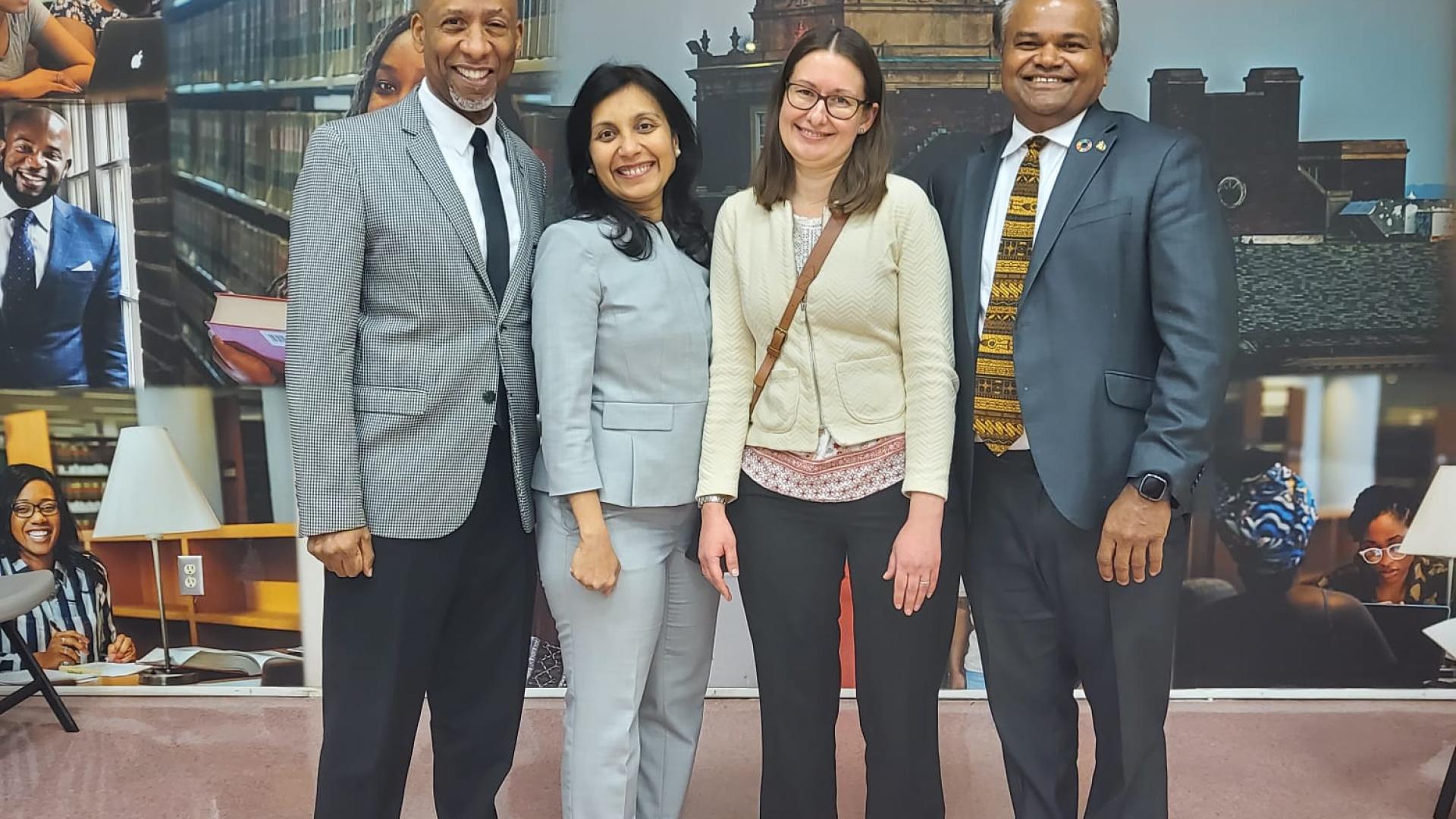
Carlton Waterhouse, Ph.D. is a professor of law at the Howard University School of Law. He is an international expert on environmental law and environmental justice, as well as reparations and redress for historic injustices.
In 2021, Waterhouse was appointed by President Joe Biden in the role of Deputy Assistant Administrator for the Office of Land and Emergency Management at the United States Environmental Protection Agency and nominated to the United States Senate to serve as the assistant administrator for the Office. During his two years serving in the Biden-Harris Administration, he oversaw the nation’s programs for toxic waste site remediation, community revitalization and redevelopment through contaminated site cleanup, hazardous and solid waste materials management, chemical plant safety, and emergency response to toxic spills, fires, and explosions.
Waterhouse lectures globally on climate justice, reparations and reconciliation, and group-based inequality. In 2019, he testified on reparations before the Inter-American Commission on Human Rights of the Organization of American States and in 2018 he completed a Fulbright research fellowship in Brazil examining race and police violence. His views have been published in the New York Times, the Wall Street Journal, and many other media outlets. His scholarship includes essays, articles, and book chapters focused on the ethical and legal dimensions of environmental justice and reparations. His forthcoming book with Cambridge University Press explores the historic and contemporary role of the United States Supreme Court in both maintaining and dismantling racial dominance.
He is a member of American College of Environmental Lawyers, the International Sustainable Development Research Society, a board member of the Environmental Law Institute, and the Natural Resources Defense Council. He sits on the National Academy of Sciences Climate Crossroads Committee and actively participates in national and local organizations protecting civil rights and advancing environmental protection and justice. Using an interdisciplinary approach, he examines critical social issues facing the country and the world. Dr. Waterhouse is a Professor of Law and the founding director of the Environmental and Climate Justice Center at the Howard University School of Law. The center conducts environmental justice research and advocacy that supports local communities confronting environmental injustices and provides policy interventions that promote environmental justice in local, national, and global arenas.
Ethics
Emory University
2006
Ethics
Emory University
1999
Law
Howard University
1991
Pennsylvania State University
1989
Specialty Areas: Environmental Justice, International Environmental Justice
Specialty Areas: International and Domestic Reparations, Title VI of the Civil Rights Act of 1964, Race and Law before the United States Supreme Court
Clean Energy and Environmental Justice in Communities
Watch: National Academies Discussion on Economic Inequality and Climate Change
Read: The Guardian | ‘Our now-weary bodies have held on’: 109-year-old Tulsa massacre survivors get day in court
Read: WWNO | Shuttered EPA investigation could’ve brought 'meaningful reform' in Cancer Alley, documents reveal
Read: The Washington Post | In rage Rooms You Can Destroy Printers with Sledgehammers
Read: Waste Dive | Waterhouse: Less plastic production, stronger state laws could curb environmental justice impacts
Read: Missouri Independent | Kids in the Midwest will get more blood screenings under EPA plan to deal with lead threat
Read: Alaska Public Media | EPA official says agency is committed to cleaning up contaminated Native corporation land
Read: New Orleans Advocate | EPA says it could help pay for Gordon Plaza relocations after site tests, review
Lead: The Latest Federal Actions and Best Practices
Lead has an old and even ancient legacy of harm to humans. 1 Despite this history, lead was widely used in the development of consumer goods used for and around children in the United States during the industrial era. 2 The decision to use it in two widely distributed commercial products created a public health nightmare. Leaded gasoline and leaded paint robbed countless children and adults of opportunities for greater economic prosperity, educational achievement, and deeper social engagement. 3 Moreover, death and disease have been visited upon millions of unsuspecting families and individuals around the world because of their exposure to lead. 4 In the United States alone, deaths attributable to lead exposure have been estimated at over four hundred thousand. 5 At the global level, the World Health Organization has made the following determinations: Lead exposure can have serious consequences for the health of children. At high levels of exposure to lead the brain and central nervous system can be severely damaged, which could result in a coma, convulsions, and even death. Children who survive severe lead poisoning may be left with permanent intellectual disability and behavioral disorders. At lower levels of exposure that cause no obvious symptoms, lead is now known to produce a spectrum of injury across multiple body systems. In particular, lead can affect children's brain development, resulting in reduced intelligence quotient (IQ), behavioral changes such as reduced
Environmental Justice: Law, Policy & Regulation 4th Edition
Environmental Justice: Law, Policy & Regulation explores current theory and practice concerning disproportionate environmental impacts on people and places. Based on decades of experience with community engagement, interdisciplinary scholarship, and legal authorities including environmental law and civil rights, Environmental Justice examines the range of environmental threats presently facing vulnerable populations, including communities of color; poor, immigrant, and Indigenous communities; and women, children, and older adults.
The fourth edition provides updated materials to address contemporary environmental justice concerns, including hazardous air pollutants in "Cancer Alley"; contaminated lands from the Arctic to the Southwest; drinking water contamination in Flint, Michigan, and Jackson, Mississippi; and the devastation wrought by hurricanes, wildfires, and other climate-related disasters across the United States. It also examines the aftermath of the COVID-19 pandemic and innovations for advancing environmental justice during the Biden administration, plus challenges and opportunities to continue progress during the second Trump administration.
Featuring a new chapter considering international concerns for environmental justice, this new edition also expands coverage of cumulative impacts, state and local initiatives, climate justice, disaster justice, and food justice—all with an eye towards identifying modern challenges and available tools for the continuing pursuit of environmental justice.
Climate Redress Revisited: Loss and Damage, Compensation, and Reparations
Extreme events related to climate change continue to grow in frequency and consequences. Often, the nations most harmed are those least responsible for climate impacts. This dynamic has led some scholars to call for reparations to hold states accountable. This Essay reviews scholarship proposing redress for climate-related harms considering redress and reparations history and literature. To address accountability concerns, it maintains that the Loss and Damage Fund under the United Nations Framework Convention on Climate Change establishes a floor of responsibility for nations contributing to climate change. Further, by drawing on the “polluter pays” and “no harm” principles under international law, the Essay proposes the development of climate compensation funds to address the needs of the most vulnerable countries left unmet by the loss and damage framework. The Essay outlines key features of a climate compensation mechanism utilizing newly enacted climate cost recovery legislation in New York. It concludes by rejecting broad claims for reparations based on climate change—offering instead a narrow case for climate reparations growing out of historic uses and scholarly models of redress.
Exiting the Road to Resentment: Moving from Reactionary Reconciliation to Social Healing with Justice in World Environment and Island Studies, Vol. 7, No. 4 (pp. 175-183). (2017).
The call and the need for reparations grows out of some of the worst abuses humans have inflicted upon one another. In the aftermath of past atrocities, societies often grapple to understand their identity. They routinely struggle to reconcile their contemporary moral standing with their past actions. Pressure from internal and external groups often force governments to publicly denounce past injustices and mistreatment to establish or sustain political legitimacy. Pursuing this brings them squarely into the world of reconciliation and redress. In less than a century, countries on every continent have confronted this issue. Their approaches and outcomes have varied just as widely but lessons from their experience should guide ongoing and future efforts to achieve success.
Reparations: The Problem of Social Dominance in World Environment and Island Studies, Vol. 6, No. 1 (pp. 11-19). (2016).
In theory, reparations provide redress for past injustices. They reflect political attempts to seek to balance the scales of justice in the wake of crimes against humanity, gross human rights abuses, and other tortious state action. As one of the more politically salient legal academic subjects, however, it is clear that the sociopolitical processes within and between states greatly influence when, why, and how reparations are used. Reparations theorists have done an excellent job developing vital models for use by states to provide warranted redress.
The Lingering Life of Lead Pollution: An Environmental Justice Challenge for Indiana
When the U.S. Environmental Protection Agency (“EPA”) initially tackled the issue of race- and class-based inequities in Americans’ exposure to harmful pollutants it recognized that little research had been done on the issue as a whole with one exception—lead exposure. Today, twenty-two years later, lead exposure in children has drastically decreased but the statement above remains true—Black children continue to have substantially higher blood lead levels than their white counterparts even when socioeconomic variables are accounted for. Indiana is no exception. African Americans and Hispanics continue to show higher rates of elevated blood lead levels than their white counterparts in Indiana.
Elevating Environmental Protection and Our Priorities in Howard Magazine
Climate vulnerability disproportionately affects African American communities. One way to change this? At the polls.
Protesters in the U.S. have been crying out for cities to 'defund the police.' But what does that really mean? CGTN's Asieh Namdar spoke to Professor Carlton Waterhouse, from Howard University for more on this terminology.