
Doctor of Philosophy (Ph.D.)
Classics (Greek, Latin, Sanskrit)
Indiana University (Bloomington)
2008
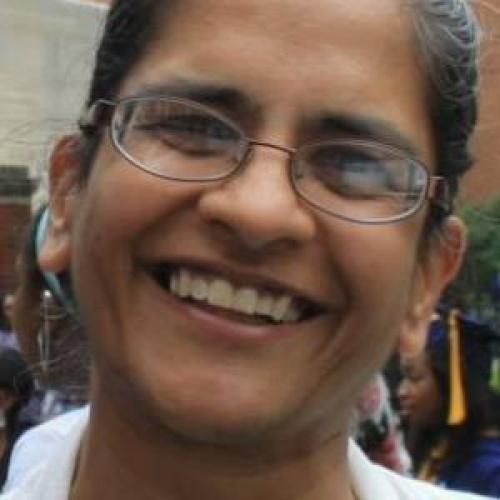
Arti Mehta, Ph.D. is an adjunct lecturer in the Department of Classics at Howard University. Mehta earned an undergraduate degree in English at San Francisco State University, with a focus on poetry and on literature by women. On formally entering the field of classics in graduate school, she acquired the languages of classical studies (M.A. in Greek), the methodologies of comparative literature, and the religious, philosophical, and story-telling perspectives of India studies. She was a Summer Fellow at the American School of Classical Studies in 2000, awarded the Semple Grant from the Classical Association of the Middle West and South. Indiana University graduate student and dissertation fellowships led her to write a thesis on Greek, Latin and Indian fables under the aegis of Eleanor Leach, Ph.D. thereby earning a Ph.D. in Greek with minors in Latin and Sanskrit. A project on the philosophy of Jainism, conducted in India, was adopted into her high school library; her dissertation was accepted by the Library of Congress. Mehta teaches language and literature classes in the Department of Classics.
For twenty years Mehta has taught ancient languages - Greek, Latin, Sanskrit in prose and poetry - to students of all ages at various institutions and to distance learners from Africa and Asia. She has instructed lecture and seminar classes on ancient and comparative mythology and its modern retellings, satire and comedy, Greek and Roman culture, art and archaeology, medical and scientific terminology, writing composition, graduate research in Latin, as well as humanities classes in oral traditional literature and tragedy. Mehta wrote a handbook for Wheelock’s Latin, reviewed a proposed Greek textbook, introduced children to ancient Greek culture at the Greek Embassy in Washington, D.C., and mentored students’ undergraduate research projects. As a co-principal investigator for an NEH grant to expand the classics curriculum by incorporating the greater Mediterranean region, she focused on West Asia; modules on ancient river cultures often appear in her classes. She intends to develop a one-semester section of Ideas in Antiquity into a course on ancient popular culture, drawing upon folkloric and performative genres from the Mediterranean, Africa, and Asia.
Mehta’s research interests include comparative folklore, forms and methods of story-telling found in fables and Greek lyric poetry, Greek and Latin grammatical and rhetorical handbooks, political appraisals of ancient writers, as well as literary representations of women. Recently Dr. Mehta has presented comparative projects on Aesop as an Indian rishi at the University of Maryland College Park; Horace and Huey P. Newton at the Classical Association of the Atlantic States; and ancient animal metaphors from Greece and India at the Harvard University Center for Hellenic Studies with the Embassy of India. An article comparing early Greek myths of fire to ritual hymns from Vedic India is forthcoming this spring; a book on ancient divinities of fire is in progress.
Classics (Greek, Latin, Sanskrit)
Indiana University (Bloomington)
2008
Greek
Indiana University (Bloomington)
1998
English
San Francisco State University
1993
Satire and Comedy has evolved from a general survey of ancient authors into a class where students analyze characters by reading philosophical excerpts (Aristotle, Theophrastus, Horace) and modern theories of humor to discover these ideas in ancient and modern poetical and performance genres.The class reads animal stories, Aristophanes’ satirical plays, Menander’s family dramas, Roman comedies, and Lucian’s comic dialogues; the ancient texts are balanced by a steady stream of contemporary luminaries such as Tyler Perry, Nick Cannon, and, most recently, Kevin Hart.
Women in the Ancient World introduces students to a range of historical and mythical women from Greece, Asia, and Africa to consider what we know about their daily experiences, their family and love relationships, and their event-filled lives. First time-taught in AY 2018-2019, this course sifts through writings by both male and female writers in order to recognize and identify women and other marginalized peoples from ancient times. Readings focus on the great goddess, love, sex, and marriage, rulers and heroines, Greek tragedies, and Roman love poetry.
Co-Principal Investigator: NEH Proposal accepted (Dr. Molly Levine), “From ‘Classical Civilization’ to ‘Ancient Mediterranean Studies’: A Proposal for Curricular Innovation.” January 2013 - December 2015.
Co-Principal Investigator: NEH Proposal submitted (Dr. Segun Gbadegesin), “African Moral Traditions and the African Diaspora: Community, Individuality, and Moral Revolutions.” 2014.
Classical Association of the Atlantic States, “Horace and Huey: Satire as Persona in Intellectual Conversation”, 10 October 2015
Harvard University’s Center for Hellenic Studies (D.C.) in association with the Embassy of India, India and Greece: Four Comparative Approaches with Gregory Nagy, Douglas Frame, and Subha Pathak, “Fox and Jackal: Individual and Collective”, 13 February 2015
Classical Association of the Atlantic States, Panel on Online Education: A House of Cards? “Classics into the Twenty-first Century: Online Education”, 11 October 2014
Howard University Collaborative Research Project, Moral Traditions and Moral Revolution II: Perspectives from the Humanities, “Ancient Tricksters and Folkloric Revolutionaries”, 14 October 2011
Classical Association of the Middle West and South, “Constructing and Deconstructing Identity in Theon’s Progymnasmata”, 13 April 2009.
Marist College Women’s Studies Colloquium, “Speaking the Character of Aphrodite in Sappho’s Fragment 2,” 6 September 2005.
Classical Association of the Middle West and South, “What’s in a Fable? The Rhetoric of Personalized Authority in Horace’s ‘The City Mouse and the Country Mouse’,” 1 April 2005.
Classical Association of the Middle West and South, “What Hesiod is to the Ancient Greek Fable: First Speaker, First Narrator, First Messenger,” 2 April 2003.
Classical Association of the Middle West and South, “What is a Theran Little Priestess? An Outline of Early Eastern Mediterranean and Indian Semiotics on Women,” 7 April 2000.
Classical Association of the Middle West and South, “Alter Seneca: Reading the Post-Colonial Relationship between Seneca pater and Porcius Latro,” 16 April 1999.
Classical Association of the Middle West and South, “Characterizing Aphrodite: The Role of the Speaker in Sappho fr. 2,” 16 April 1998.