Doctor of Philosophy (Ph.D.)
Chemical Engineering
SUNY College of Environmental Science and Forestry
2023

Chemical Engineering
SUNY College of Environmental Science and Forestry
2023
Bioprocess Engineering
SUNY College of Environmental Science and Forestry
2019
Bioengineering
Beijing University of Chemical Technology
2019
Utilization of Hemp Processing Waste for 3D Printing of Biocomposites
Unlike stem biomass, the residues after the extraction of cannabidiol (CBD) oil from hemp flower are challenging to utilize because of their high extractive content (~ 40%, mainly lipids) and are typically considered waste and landfilled. This study presented a novel approach to effectively valorize this underutilized hemp processing waste via chemical processing for three-dimensional (3D) printing applications.
Lignocellulosic biomass has been well-acknowledged as a filler for making 3D printed composites. The technical performances of composites were influenced by the characteristics of the components. The correlations between poplar biomass properties and the mechanical and thermal performances of the 3D printed poplar-plastic composites were investigated. The characteristics of poplar were modified by different pretreatment methods, including using hot water, dilute acid, and organic solvent (organosolv), and each treated poplar biomass was applied as a filler in a polylactic acid (PLA) polymer matrix to produce eco-friendly materials. These solvent pretreatments increased the hydrophobicity and surface area of poplar. Organosolv treated poplar showed the highest cellulose content and significantly increased Young's modulus of its biocomposites. Principal component analysis revealed that the specific surface area and water contact angle of biomass contributed to the thermal stability of biocomposites. Additionally, the degree of polymerization of cellulose and xylan content within the biomass correlated with the biocomposites' break stress. Notably, the crystallinity of biocomposites impacted the modulus of these materials. The reported relationships between biomass characteristics and 3D printed composite behaviors provide guidance for optimizing biomass processing in biocomposite applications.
Lignin and castor oil with intrinsic hydroxyl groups are attractive green resources for polyurethane (PU) applications. However, lignin's heterogeneous and highly crosslinked structure, poor processability, as well as the feedstock variability, lead to inconsistent and poor performance of the final foam products. Castor oil-based polyurethane foam (PUF) has a relatively high price and density, which are big hurdles to its practical applications. In this study, we hypothesized that synergistic bio-polyol mixtures composed of lignin and castor oil could balance the drawbacks from individual component.
Lignin is a low-cost and renewable bioresource with a huge annual production promising to prepare sustainable materials. However, the poor interfacial adhesion between many lignin-polymer pairs deteriorates the mechanical performance of the composites, which seriously limits the application of lignin in 3D printing via fused depositional modeling. This work examined lignin-polyamide 12 (PA 12) intermolecular interactions (e.g., hydrogen bonding) to address the interface challenge.
3D printed lignin/polymer composite with enhanced mechanical and anti-thermal-aging performance
Lignin is the most abundant natural aromatic polymer globally but is still underutilized as a renewable material, even with its versatile properties. One approach to using lignin is to incorporate it in polymer composites, but this application is often limited by the poor mechanical performance of the resultant composite due to the poor interfacial adhesion. Following the structure–property relationship, stronger interactions were designed to be enhanced by alternating the functional groups of lignin. This study applied a demethylation method to hardwood lignin (Ori-Lig) to introduce more phenolic hydroxyl groups. Research studies with rheology behavior and molecular simulations demonstrated that an increased phenolic hydroxyl content could improve the adhesion between the modified lignin (OH-Lig) and the polymer matrix at the interface.
Anqi Ji, Utilization of Biomass and Industrial Waste in 3D Printing, Lakehead University, Virtual seminar, Jan 29, 2026.
Anqi Ji, Exploring Academic & Career Pathways, Beijing University of Chemical Technology, Virtual seminar, December 18 2025.
Anqi Ji, Utilization of Wastepaper Fibers on 3D Printed Polymer Composites, International Conference on Advances in Life Sciences (ICALS-2025), Virtual seminar, January 9, 2025
Anqi Ji, Exploring Academic & Career Pathways, Beijing University of Chemical Technology, Virtual seminar, December 17, 2024.
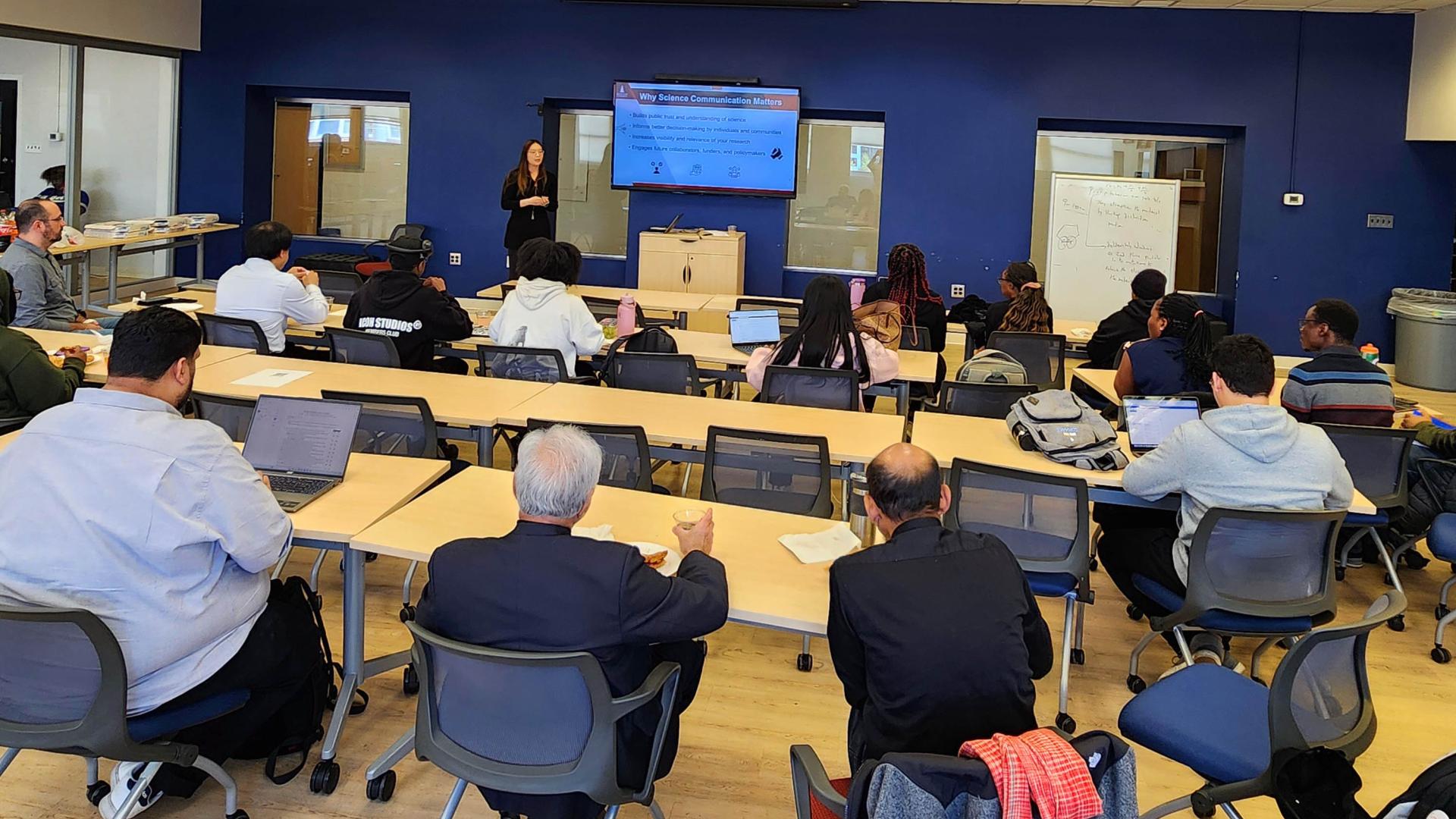
Anqi Ji, Utilization of Biomass and Industrial Waste in 3D Printing, HU Department of Chemical Engineering, Washington DC, September 9, 2024.
Anqi Ji, Polymerization of Styrene and Lignin: Production and Characterization, Forest Products Laboratory, Virtual seminar, July 10, 2024